
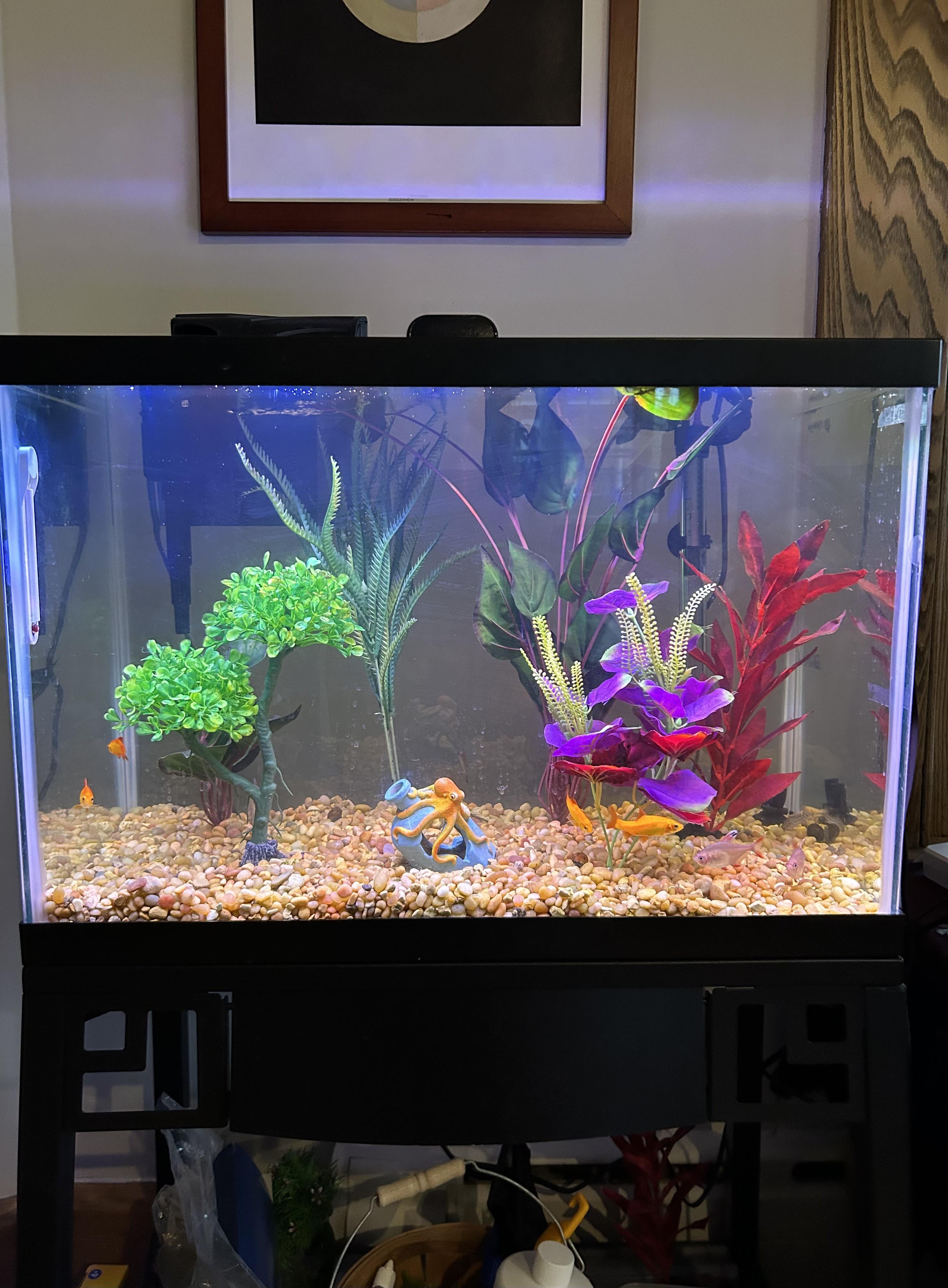
Hi – 20gallon community tank, 2+ years established, with 12 small fish, plastic plants, and 4 tiger nerite snails added a month ago after an unusual algae/bacteria bloom, the tank water became milky pale-green-tan-white. I believe the bloom was caused by lots of sunlight hitting the tank during the winter months when the sun is lower (northeast US) and shining more directly into the tank 4-5 hours each afternoon.
The challenge is that I overcorrected in treating the bloom with a few products plus sunlight blocking, and the tank now appears to be very low-algae. I do a weekly 1/3 water change and added some beneficial bacteria from the fish store in case I wiped that out too. Snails seem active enough and look healthy but the decor is seems algae-free lately. Are they getting enough? I don’t feed them anything, was told algae is all they need. See the photo, ceramic octopus in center is staying orange lately, it used to turn pine green from algae. Ph is kept around 7.2 to 7.5 and the light’s on a timer 730am-430pm. Should I let the sunlight back in? Do anything else? I want some signs of more algae but don’t want to unleash another out-of-control bloom. Thanks!
Posted by ThoughtIndividual114
1 Comment
You really need just 1 nerite snail for light algae issues in a 20 gallon, for comparison I started with 8 nerites in my 55 gallon with severe algae and after a week had to move the snails to other tanks. I only keep 3 in there now and the tank is always spotless. Just because you can fit “1 nerite per 5 gallons” doesn’t mean you need to fill the tank with them.
You have to feed them algae wafers or “snello” if there’s not enough algae for them to munch on passively. As far as natural algae boosting add more light and nutrients to the tank, get some slow growing plants and add some fertilizers once a week. Algae will grow to eat excess waste the slow growing plants aren’t eating fast enough.
Though really, those nerites just work that hard! I hate to say it, but better at algae eating than my shrimp even, and they eat that hard spot algae that other snails don’t touch too!