
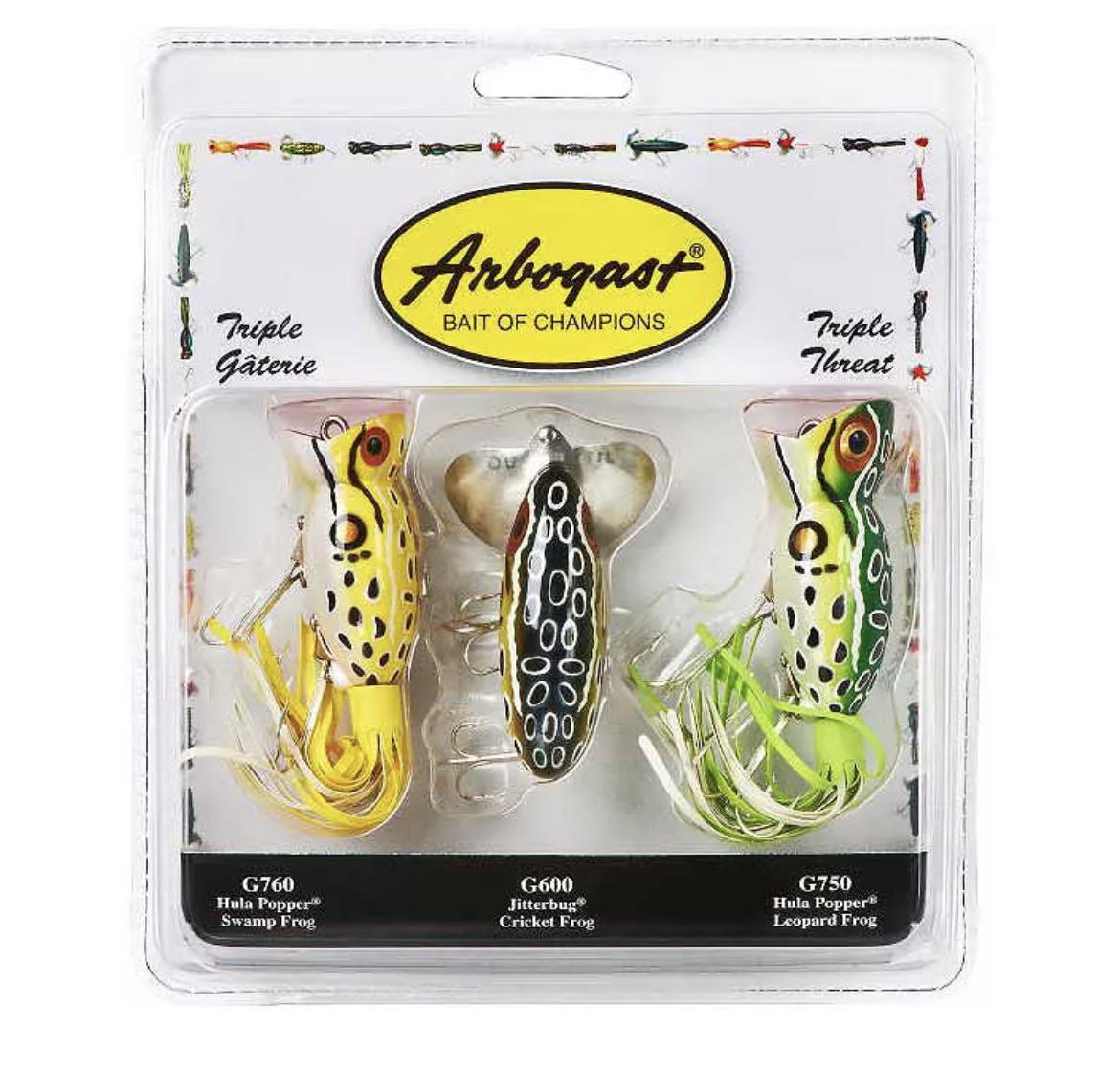
Despite an earlier post vowing to use chatterbaits only this season, they were selling these three-packs for sixteen dollars and I just had to try it. Ended up getting two hula poppers (one is slightly larger than the other) and a jitterbug. These are all painted in fairly naturalistic frog schemes as you can see (genuinely really like the cricket frog’s design), so am I wrong to assume I throw these around places where bass are accustomed to hunting frogs, like reeds and swampy shorelines and things?
I got the hang of the glub-glub noise and making the little satellite dish on the jitterbug rattle, but are there any little tips and tricks people have came up with in the 80+ years they’ve been on the market?
Posted by JacquesNuclearRedux
3 Comments
Non weedless frogs never really get action for me
Think of those as poppers and a moving topwater bait, ignore the frog part. It is fine to fish them in those places but fish won’t see the paint, or think they are frogs.
Those are excellent, but likely better during the middle to end of summer, when the water is hot and they come up in the mornings/evenings to feed in the shallows. The center one is similar to a “walk the dog” technique with a Zara spook, but it performs it on its own. Irregular retrieve with pauses every 5-10 wobbles. Sometimes harder, sometimes softer.
The two outside poppers are great as well, but I prefer the rebel pop’rs myself. Anyway. Two or three quick jerks with a pause between the set. Whipping the tip toward you (downward not up) and taking up slack line between jerks. Downward keeps the line closer to the water and makes the action more erratic. The key is not jerking on it and pulling it out of the mouth of a striking fish. Let the pause rest. Patience is key. The pause is vital for poppers. They imitate splashing shad or frogs on the surface. You don’t throw these into vegetation, you use them around the outsides of vegetation, and parallel with the shore for more strike zone time. (Although retrieving them toward a boat, perpendicular to the shore, is excellent too). Throw around structure. Bridges, logs, stumps, rocky bottoms, etc. I’ve had success all fishing season on top water, but it definitely gets better toward the end of the season during feeding windows.
I’ll suggest one more top water choice. It’s available at Walmart so it’s pretty easy to find. A “strike king mini buzz” in black with the silver wire form. It’s so small, it is very effective. The particular splash of that buzz bait is as close to natural sounding as you can get. They’re light enough for slower retrieve. And the black is excellent. And relatively cheap. I’ll buy a dozen at the beginning of the year, just to have them. They get harder to find as the year goes. They work well in river settings too. My largest smallmouth ever was on that lure in April, in a river.
Also, I Texas rigged dark worm/tube is always great. Peg the weight (1/8-1/4 or even 1/2 ounce) with a toothpick so it doesn’t slide (from underneath). By pegging the weight you’ll feel ANYTHING that touches it. If you think you’re too slow, go even slower. The lighter weights let it sink more slowly, with great action, but the heavier weight lets them get to the bottom faster, if you’re fishing a drop off. Soft plastics are always successful if fished properly. If the toothpick sticks out the top of the weight, bite it off with your teeth and reinsert. It’s foolproof at that point.
Sorry for rambling. Best of luck, man!
Edit: use 1/0 – 3/0 EWG (extra wide gap) hooks for your soft plastics. Rig them and then insert the tip right under the skin of the plastic. Completely weed proof.