
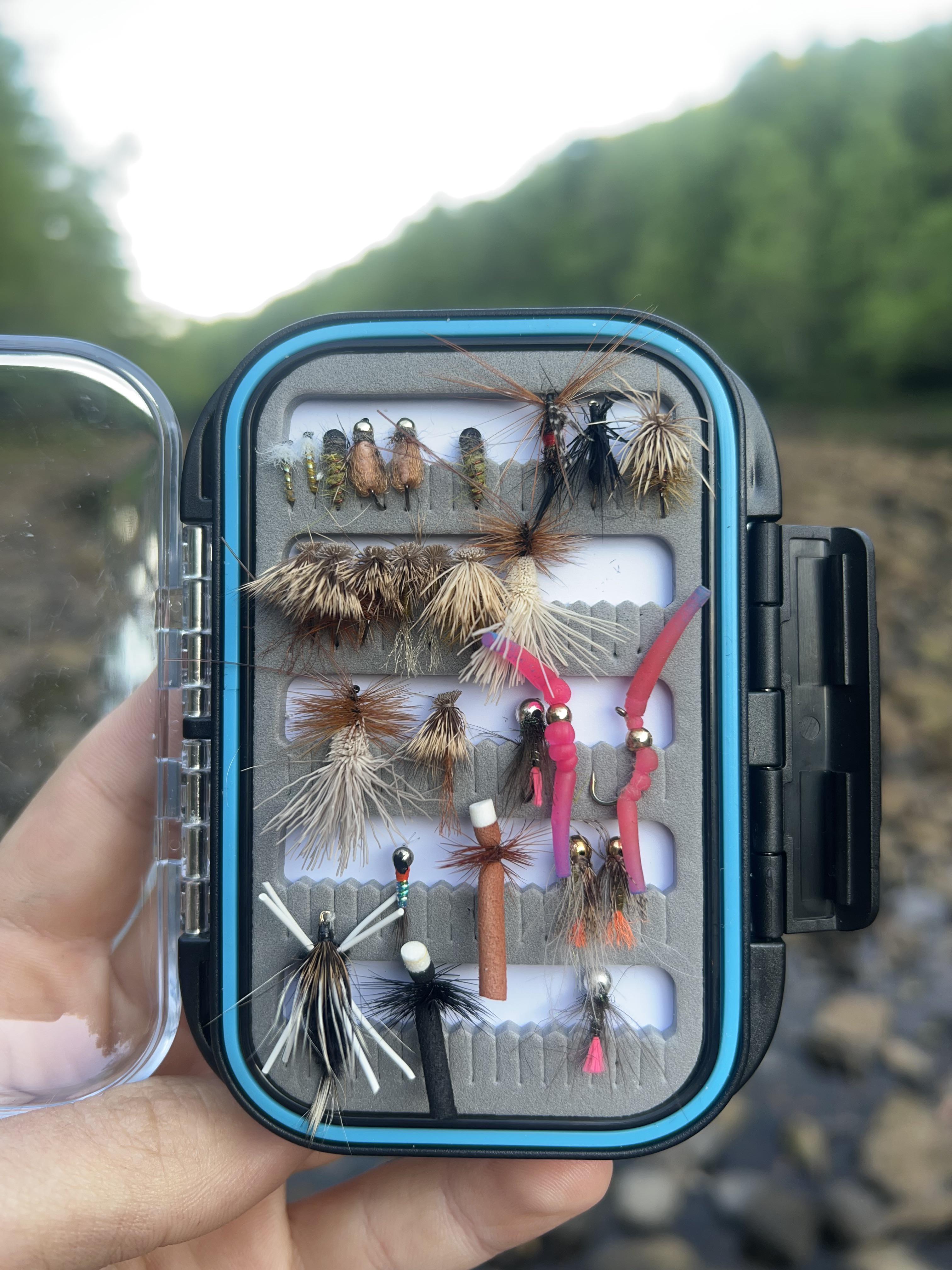
I’m pretty new to fly fishing. Today I went to Sipsey Fork in Central Alabama for the second time to try to get some trout. It was a beautiful day with no wind and the current was not very strong. I found a hole where trout were surfacing pretty continuously however I could not get them to bite on anything. I tied on everything in my box. I tried dry flies and then a dry dropper rig and finally a squirmy wo with an indicator with no luck. I think most of the patterns that I was using were Caddis. Is it too early in the season to use caddis patterns? The only insects that I saw were little gnats and some dragonflies. i’d appreciate any advice on how I can improve next time I go out because I feel like I wasted a pretty good opportunity today with how much fish activity there was. Thanks!
Posted by Acrobatic_Scar8774
10 Comments
Is that a cigarette pattern?
Maybe midges early season. Tricos? What size leader did you have on? I find early season fish to be a little spooky.
Try to identify what they are feeding on. At least look for approximate size and color of what they are feeding on. If you can’t, just keep changing up different variety offlies until you get something.
Also could have been that your tippet was too large. Spookie and more pressured fish can be wary of visible leaders. Make sure you also have a good presentation, i.e. a “drag free drift”.
Put a Wooly Bugger or two in that box!
Fly quality isn’t great. And I’m guessing everything you’re throwing is too big and too splashy. I hate fishing tiny stuff just as much as the next guy but sometimes you just gotta do it.
Do a dropper with one of those elk hair caddis and a small midge. You’ll crush em. Smaller the better sometimes
It sounds like they were probably eating midges or maybe really small mayflies. When trout are keyed in to a specific insect, like midges, they will typically ignore things that don’t match (where the term “match the hatch” comes from). If a trout is eating small bugs, there usually won’t move on a big one, they are weird like that.
I would look into getting some small (18-20) midge and baetis patterns that roughly match whatever insect you were seeing on the water. If tiny midge dries aren’t your jam, check out a griffith’s gnat which can imitate clusters of midges when fished in larger sizes (14-16).
Hey! I am new as well. I have been doing it for a little over a month and loving it so far! I have learned that if you don’t visibly see fish rising and eating flies at the surface, then flies usually won’t work. If you do, your presentation and fly size has to be almost exact same as the real flies dropping on the water. In the mean time, try nymphing with a hopper-dropper method. This is what has been working for me so far. Look up videos and how-to’s for this method. Get yourself some zebra midges, chironomids, Prince nymphs, copper johns, 5x and 6x leader and tippet, and some chubby chernobyl. Tie the chubby chernobyl to the leader. Cut a pieces of tippet about 12-18″ long and tie it directly on the hook of the chubby Chernobyl using a standard clinch knot. Then tie a nymph/midge of your choice to the end of the tippet. Make sure the nymph has a bead head or you will need to add weight to make it sink. Throw your line out and the chubby should float, acting as your strike indicator. Let it drift and once it goes under, set the hook!
I’d add some smaller patterns. Hard to tell for sure, but the dry flies look like 12s or 14s maybe, and if they’re hitting midges, I’d start with 18s or 20s, maybe a small (18/20) parachute Adams, and trail a 20 zebra midge or other midge pattern. Around here (CO) I love Manhattan Midges for that. Or just use a bigger caddis as your dry fly and trail a midge pattern behind that.
Also try to find some videos on rising fish. Many times you’ll see the rise, kind of a bulge sometimes, but no ‘bubble’ or splash, and it just means they might be hitting an emerger of some kind, maybe midges. If they’re hitting adult caddis or mayflies, you’ll see the bugs and sometimes very splashy/aggressive rises.
If they are hitting emergers, you can fish emergers, or maybe just unweighted nymphs and midges just under the surface. I’ve caught a bunch of fish with unweighted pheasant tail nymphs fished just under the surface. You can ‘grease’ the leader with floatant to maybe 12-18″ from the fly, or use a VERY small indicator.
But the basic problem is if they’re selectively hitting something, like #20 midges, they just want that sometimes, and you can go smaller and often still do fine, but often bigger will just be ignored.
Last week we came up on a run with 10-12 rising fish. 6-8 good drifts with a #16 X caddis (that’s a great fly very often in this creek), nothing. Put on an 18 parachute Adams (20 would have been fine I think) and my wife caught a great fish on her second cast. She hooked 4 of them, and after that put them down a bit, I hooked two fishing the Adams and a #22 Manhattan midge trailer, and the fish hit the midge.
You didnt use a streamer, that’s what happened loll
Go small Tiny Adams dry flys. Or, since you saw dragonflies, I might try a dragonfly nymph sub surface.