
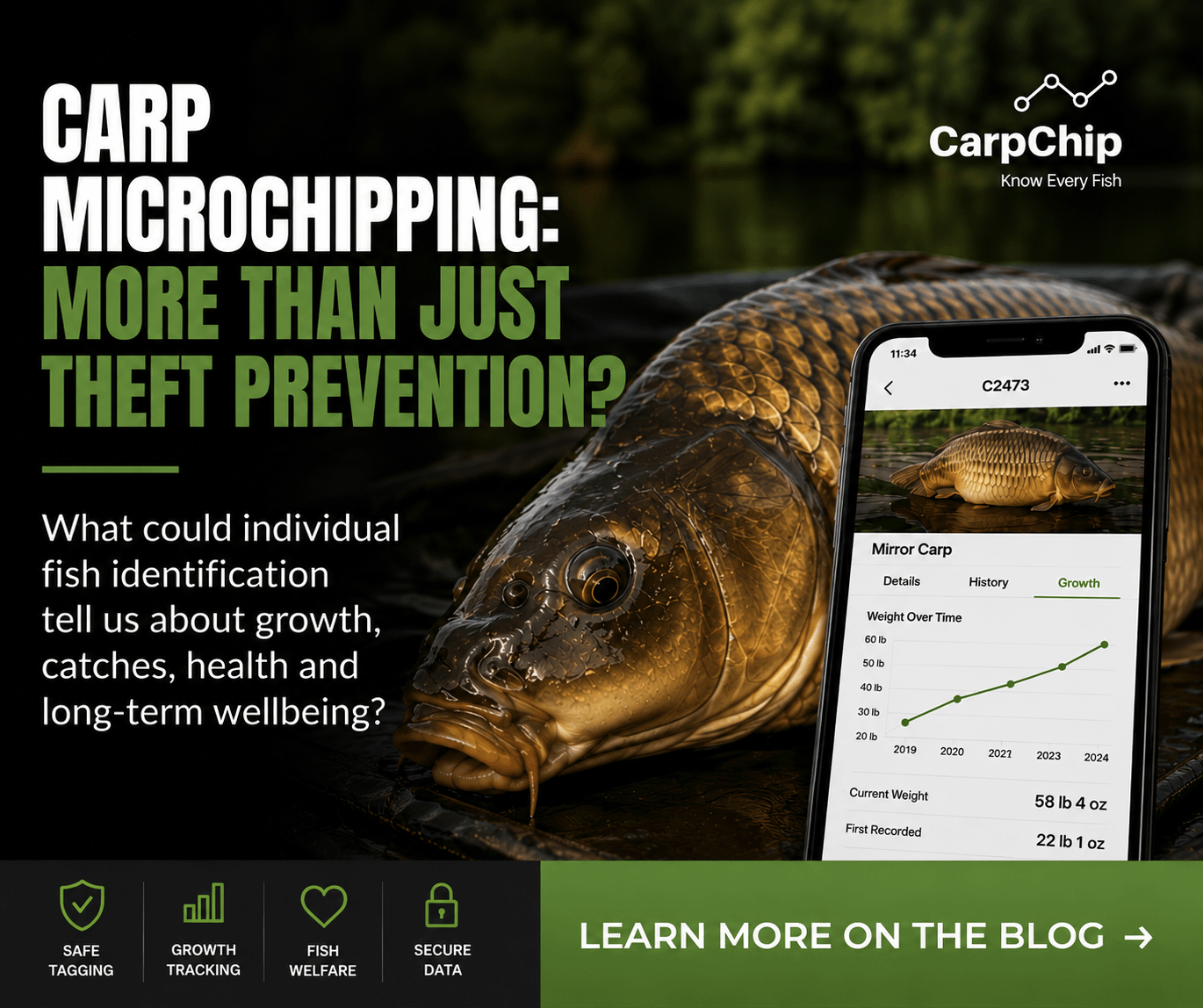
What could individual fish identification tell us about growth, catches, health and long-term wellbeing?
Fish tagging is not a new concept, and it certainly isn't limited to carp.
Around the world, scientists, conservation organisations, fisheries managers and governments use different forms of fish tagging to understand where fish go, how they grow, how they survive and how populations change over time.
Tagging and recapture programmes have contributed enormously to our understanding of fish behaviour and aquatic ecosystems.
Modern tagging programmes range from simple identification tags to microchips, acoustic transmitters and sophisticated satellite tags.
The technology may differ, but the principle is remarkably similar:
Identify an individual animal, recognise it again and learn from what happens between those encounters.
That simple principle has generated an extraordinary amount of information.
Researchers use tagging to investigate:
- migration and movement;
- survival;
- growth;
- habitat use;
- feeding and spawning areas;
- population structure;
- environmental pressures;
- and the effectiveness of conservation measures.
Some programmes operate on an enormous scale. NOAA's (National Oceanic and Atmospheric Administration, a U.S. government science agency) cooperative shark-tagging work has involved hundreds of thousands of tagged sharks, with recaptures generating movement information across numerous species and helping scientists define important fish habitats.
This is why inserting a micro chip should not simply be viewed as something that is done to a fish.
Used responsibly, it is a way of learning more about that animal so that people can make better decisions about its future.
Fish micro chips have transformed how we understand fish around the world.
From scientific research into migration and survival to the management of individual fish, the underlying principle is simple: if we can reliably identify a fish throughout its life, we can learn from what happens to it over time.
For a carp fishery, that knowledge becomes much more personal. These are often individual fish that lake owners and anglers may know for many years. Recording their captures, growth and condition can create a long-term picture of how those fish—and ultimately the lake itself—are performing.
For those who care about fish welfare and conservation, the value isn't simply knowing where a fish is. It's knowing more about the fish in your care, so you have better information with which to protect them.
Bringing the same principle into carp fisheries
A commercial carp lake may be very different from an ocean or river research programme, but the fundamental management principle remains the same.
If you can reliably identify an individual fish, you can begin to build knowledge about that fish over time.
Historically, many lake owners have identified carp through photographs, distinctive markings, names and memory.
That can work remarkably well, particularly in smaller established fisheries.
But as stocks change and records accumulate over many years, permanent identification adds another level of certainty.
A microchip gives each fish its own unique identity.
Once that identity is connected to a useful record, tagging becomes much more than a security measure.
It becomes part of the fishery's welfare and stock-management system.
The welfare benefit begins after tagging
Perhaps the most interesting part of microchipping isn't the moment the fish is chipped.
It is what becomes possible afterwards.
Every time that carp is subsequently caught and scanned, the lake can confidently identify the individual fish.
The question changes from:
"What does this fish weigh?"
to:
"What is happening to this particular fish over time?"
That is a much more useful management question.
Its current condition can now be considered alongside its previous records.
A lake owner may gradually build information showing:
- whether a fish is consistently gaining or losing weight;
- its long-term growth rate;
- how frequently it is being caught;
- when it was last recorded;
- previous weights and condition;
- previous observations concerning wounds or damage;
- whether its growth pattern has unexpectedly changed;
- and which fish have not been seen for a considerable period.
The technology doesn't tell the fishery why something has happened.
What it can do is provide the reliable identity and historical information that makes a change easier to recognise.
One measurement tells you something. A history tells you much more.
Historical record gives an experienced fishery manager information that may justify looking more closely at that particular fish.
The microchip hasn't diagnosed a health problem.
It has enabled the fishery to recognise a pattern that might otherwise have been missed.
That is an important distinction.
Good technology should support experienced fishery management, not attempt to replace it.
Building a lifetime record for valuable fish
Many fisheries contain carp that have been known and cared for for years or even decades.
Individual fish can become hugely important to a fishery, its anglers and its reputation.
Yet their history can still be scattered between notebooks, spreadsheets, photographs, social-media posts and people's memories.
Microchipping provides the foundation for something far more structured:
One fish. One ID. One history.
Protecting the fish you already have
For many commercial fisheries, the emphasis is understandably on producing desirable fish and attracting anglers.
But good fishery management also means protecting the stock already living in the lake.
A large carp can represent years of growth, care and investment.
Knowing more about that fish throughout its lifetime gives the people responsible for it another tool with which to protect that investment and, importantly, protect the wellbeing of the animal itself.
Posted by CarpChip