

Tarps hang around the edge of the large fish tank where ratfish experiments were conducted in July 2023. A weight was dropped through the vertical green tube and into the water to startle the ratfish. Photo courtesy of Mel Neill
A group of hunters settle into their blind and switch on the video feed. The room is dark, illuminated only by a few carefully placed lamps. Everyone waits quietly, watching for the target to move into position.
Minutes pass.
Finally, the animal drifts into the designated area.
Someone pulls the trigger.
While this sounds like opening weekend of deer season, it was actually a marine biology experiment. The hunters were a team of scientists and, instead of hunting an animal, we were trying to scare one.
We wanted to document a very specific behavior: a fish’s startle response.
The trigger released a weight above a tank containing a spotted ratfish; a strange, deep-sea relative of sharks and rays.
To avoid startling the fish before the experiment began, the lab windows were covered, the room was darkened, and researchers watched from behind hanging tarps while a high-speed camera recorded the tank from above. The splash startled the fish, causing it to flee.
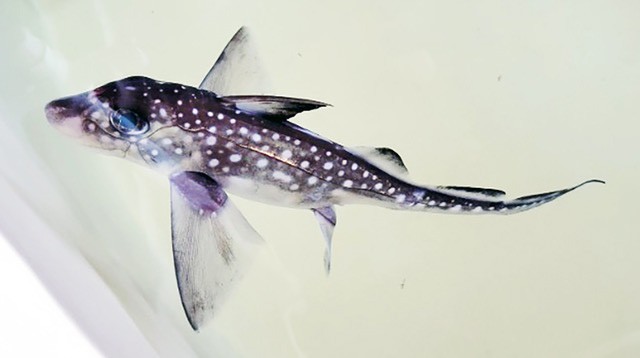
A spotted ratfish swims in a tank at the Friday Harbor Laboratory in Friday Harbor, Washington in July 2023. Photo courtesy of Mel Neill
Humans have their own version of this behavior. If someone unexpectedly slams a door behind you, you don’t consciously weigh your options before deciding to jump. Your body reacts before you’ve fully processed what happened. A fraction of a second later, your heart is racing and you’ve already spun around to investigate.
Fish face similar situations every day. The sudden appearance of a predator leaves little time for careful decision-making, so many species have an additional emergency response system that allows them to react even faster. This system bypasses slower thought processes and triggers an immediate escape maneuver.
The system is controlled by a specialized nerve cell called a Mauthner neuron or “M-cell” for short. Normal nerve pathways are already fast, but M-cells are faster still. Switching from the standard route to an M-cell is a bit like switching from snail mail to e-mail!
Most sharks and rays lose these cells as they approach adulthood, but ratfish are unusual. They belong to an ancient group called the chimaeras, which appear to keep them throughout life.

Mel Neill is a University of Texas Marine Science Institute PhD candidate whose specialty is fish biology and ecology.
That made us wonder: do ratfish react faster than their shark relatives?
When the weight hit the water, the ratfish didn’t simply swim away. Its body folded into a tight “C” before rapidly straightening again, launching the fish away from the danger.
This movement, known as a C-start, happens too quickly to appreciate with the naked eye. Only when we reviewed the footage frame-by-frame could we see the details.
The high-speed camera revealed that the ratfish reacted in just 36 milliseconds, or about one twenty-eighth of a second.
Similar experiments with dogfish sharks measured reaction times closer to 67 milliseconds, almost twice as long. While that difference may seem tiny, fractions of a second can matter when a predator suddenly appears out of the darkness.
These M-cells may help ratfish react more quickly when danger appears, which could make the difference between escaping and being eaten in the deep, dark waters they call home.
At first glance, this experiment seemed almost ridiculous. We blacked out a room, hid behind a makeshift hunting blind, and spent hours waiting for the perfect opportunity to drop a weight next to a fish.
But science is often like that. Sometimes answering an interesting question requires an equally unusual experiment.
The next time a slammed door or a thunderclap makes you jump, remember that similar reflexes are helping animals survive all around the world.
Whether you’re a person startled by an unexpected noise or a ratfish fleeing a predator in the darkness, survival sometimes depends on acting before you’ve had time to think.