
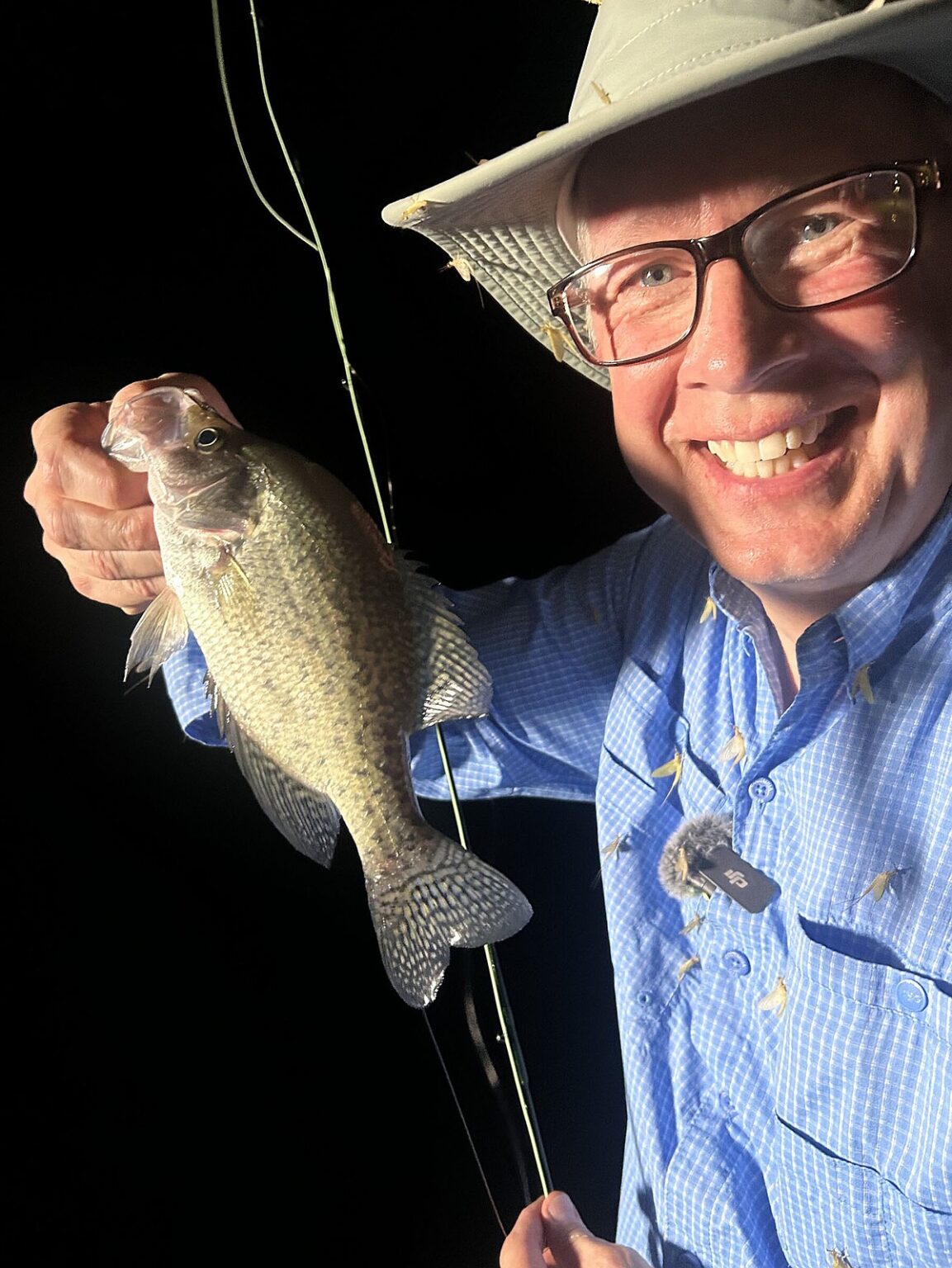
ROE — Dolly Parton had her coat of many colors. Carlton Wing wore a coat of live mayflies Thursday while fly fishing for bream on Midway Lake.
That told us what type of flies we should use during a night fishing trip under the lights at this small fishing paradise in Southeast Arkansas. I have never seen so many mayflies, and I was happy to see them.
A member of the order Ephemeroptera, the mayfly is one of the most easily identifiable insects. It has a long, slender, curved body with large, delicate, wings that remind of swan wings. They have a long tail, sometimes two, that remind me of a drake pintail’s sprigs, or tail feathers.
Adult mayflies do not have functional mouth parts, so they cannot bite. This made me, Wing and Wing’s videographer Mike Dunn very grateful. If they were equipped and inclined to behave like mosquitoes, they would have left nothing of us but bones.
Mayflies have some of the shortest lifespans in the insect world. The imago’s only function is to reproduce, and they were having a grand time of that for most of this sweltering late summer night. Bluegills devoured the ones that couldn’t resist the water.
The mayfly party started almost at the minute the onset of night activated the lights. Other bugs fell into the water under the bank of photovoltaic lights scattered around the lake, but mayflies coated the light posts and the lights themselves. When they ran out of room there, they swarmed the crew of Wing’s bass boat.
“These things seem to be attracted to mosquito repellent,” said Wing, whose clothes and exposed skin were covered with mayflies.
The reason for this visit was to film an episode of Wing’s Arkansas’s Great Outdoors television program. We shot an episode early in the summer about fishing for bass under the lights at Midway with swimbaits. We slayed the bass, but the bluegills that feasted on the bugs that fell into the water under the lights mesmerized me. An angler could have a ton of fun catching bluegills under the lights with fly fishing gear. I shared this fantasy with Jim Tom Bell of Little Rock, a member of the Roc-Roe Hunting Club that contains Midway Lake. Captivated by the notion, Bell and I tried it and had the time of our lives.
Hearing this, Wing wanted a piece of the action.
Of course, fishing at night in a small boat is challenging. During our bass outing, Wing continually rammed submerged stumps and sent Dunn and his equipment sprawling. Fly fishing intensifies the hazards. You can’t see flies zinging through the air in the dark. You only feel it when one hits you. You really feel it when one “gets” you.
You can, however, see real flies in the bright glow of Dunn’s portable studio light. Mayflies are a lot bigger than the gnats and the other insects that participate in this nightly smorgasbord. This made me nervous. Mayflies hovering around our heads were bound to attract bats, and bats creep me out.
Dunn shared a story about a bat crashing into his leg while entering an arena for a bass tournament weigh-in.
“I was like, ‘What the heck was that?'” Dunn said, reliving the experience. “It was an albino bat. It injured itself when it hit me, and it was flopping around on the floor. It didn’t bite me, thank goodness. I didn’t know what to do, so I just walked away from it.”
There are three lights near the ramp at Midway Lake. Two are close together. Curiously, bugs thronged only one light. Bluegills devouring bugs made the water practically boil. Even from a distance, their dark shapes mottled the water. The lights on the flanks had slightly different temperature profiles. They attracted fewer bugs and, consequently, fewer fish.
“Do you want to start here and work our way to these other two?” Wing asked, referring to the near light with fewer bugs.
“That one over there has the hot hand,” I replied. “Let’s start there and fish it for as long as it holds out.”
“I agree,” Wing said.
Even though mayflies were the principal menu item, I opted to keep on a black and emerald beadhead nymph that I used during my last trout fishing trip. The reason was that I didn’t want to hassle with trying to thread line the diameter of spider web through the near microscopic eyelet of a fresh fly. I caught two bluegills immediately, but fish quickly stopped biting it.
On his first cast, Wing hooked a fish that stole his lure. He spent the next 10 minutes struggling with the same dilemma.
I replaced my nymph with a small popping bug. Bluegills looked at it and even followed it, but they wouldn’t bite it.
“When there’s this many mayflies, you have to give them mayflies,” I said.
Wing agreed, sending us rummaging through our respective fly boxes. Of course, I did not have a proper mayfly imitator, but I had something close. Fortunately, I tied mine on quickly, but Wing struggled to thread the needle. I caught five bluegills on my first six casts. I counted them off as they happened. As they count increased, Wing’s movements got more jerky and more frantic as his tippet evaded his fly’s eyelet.
“When there’s hundreds and hundreds of real mayflies, how in the world do you make an imitation look as good as the real thing?” I asked.
“Law of averages,” Wing said. “A fly lands in the right place at the right time amid a feeding frenzy, and maybe you get lucky a few times.”
As the boat frequently got out of alignment with the target lights, it put Dunn in within the arcs of my casts. I hit him once, and then again, this time with the fly embedding in his shirt. Several other times I heard my fly bang against his light and camera. The usually good-natured cameraman got very annoyed with me.
Eventually we got in sync, and Wing started catching fish at a rapid clip. He also caught a crappie. I hooked a largemouth bass that got off the hook at a different light in a cove that teemed with bass. That was our only bass bite, and we were disappointed to miss the Midway Lake Triple Play.
At about midnight, the mayflies stopped flying and the fish disappeared. It was as abrupt as flipping a switch.
“I guess all these fish got full and went home,” Wing said.
“Must have,” I said. “But it will start all over again at dusk tomorrow.”
Right about then, a bat swooped between us so close that its wingtip clipped the brim of Wing’s hat. I felt the rush of air against my face.
“That does it for me,” I said. “I can’t deal with bats. Let’s get out of here.”
“It looked pretty iffy at first, with all the wasted time tying on flies and all that wild casting y’all were doing,” Dunn said. “Once y’all got it together, it worked out pretty good.”

Bryan Hendricks has been the Arkansas Democrat-Gazette outdoors editor since 2005. He covers hunting, fishing, camping, and all other outdoor activities in The Natural State, as well as the Arkansas Game and Fish Commission. Bryan has won 30-plus awards for his work, including the Arkansas Press Association Freedom of Information Award, Service to Freedom of Information Award (Associated Press Managing Editors), Reporting on Freedom of Information Issues Award (Society of Professional Journalists), the John Robert Starr Award for Excellence in Journalism, and the Arkansas Wildlife Federation Conservation Communicator of the Year Award.