
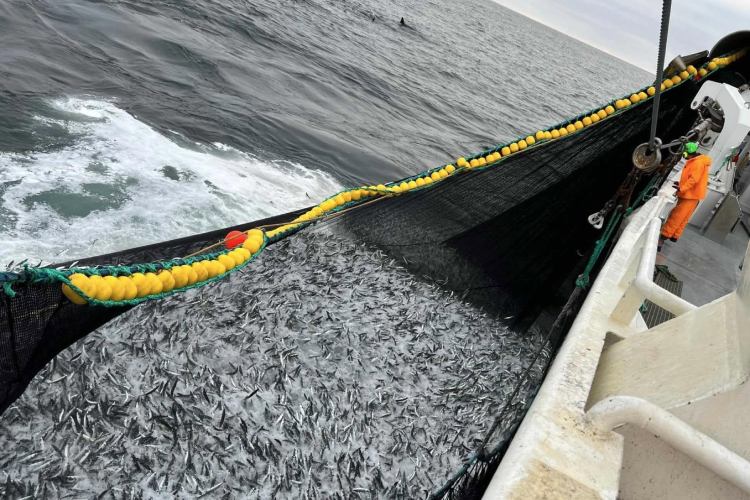
Mackerel Landings Reach 23,000 Tonnes in Strongest Autumn Week
Norwegian mackerel fishing delivered its strongest week of the autumn so far, with 23,000 tonnes entered in the catch reporting journal, according to the latest figures from Norges Fiskarlag.
The best day was Tuesday, when 9,200 tonnes were reported, while Thursday produced just 500 tonnes, underlining the highly unpredictable nature of the fishery.
Purse seiners accounted for the majority of the week’s landings with 16,900 tonnes, followed by SUK vessels with 1,300 tonnes, the coastal fleet with 700 tonnes and trawlers with 600 tonnes.
A further 3,500 tonnes were reported by 12 foreign vessels, ten of them from the Faroe Islands.
The main fishing activity took place in the Norwegian Sea, in familiar grounds approximately 140-170 nautical miles north-west of Ålesund. Just under 1,000 tonnes were also taken on the Viking Bank during the weekend.
As is typical at this time of year, the mackerel has proved highly unpredictable. Large concentrations can appear one day before disappearing for several days.
The mackerel targeted during the first part of the week was moving rapidly south-west and is believed to have subsequently moved into the British zone of the Norwegian Sea.
Large Mackerel Dominates Norwegian Sea Catches
The fish being caught in the Norwegian Sea has been notably large, with average weights ranging from 400 grams to as much as 600 grams.
The weighted average was 522 grams.
Mackerel caught on the Viking Bank was smaller, with an average weight of 375 grams.
The contrast with catches closer to the Norwegian coast is particularly stark.
Coastal Fleet Struggles With Small Mackerel
For the smaller vessels operating along the Norwegian coast, however, the picture remains considerably less encouraging.
Reports indicate only modest quantities of mackerel, while the fish that is being found is generally very small.
The coastal fleet has reported just 190 tonnes from grounds stretching from Tysvær in the south to Haram in the north.
Fish sizes in these areas range from 220 to 400 grams, with a weighted average of only 273 grams.
There is some hope among the coastal fleet that fishing could improve around the new moon, when mackerel is expected to respond more readily to light.
46,000 Tonnes Of Norwegian Mackerel Quota Remains
Of Norway’s available mackerel quota of just over 77,000 tonnes for the year, around 31,000 tonnes has now been caught.
That leaves just under 46,000 tonnes remaining.
Several vessels, particularly among the purse seine fleet, have already caught their allocated mackerel quotas.
The immediate question is whether the Norwegian Sea fishery will continue in the coming days, or whether vessels will have to shift their attention to the British zone of the North Sea.
Last year, the final mackerel catch reported from the Norwegian Sea came on 13 September, while the first catch from the British zone was reported two days later, on 15 September.
The coming week should therefore provide a clearer indication of whether this year’s Norwegian Sea fishery is approaching its end.
North Sea Herring Landings Rise Slightly
North Sea herring landings also increased slightly during the latest week, reaching 4,300 tonnes.
Foreign vessels accounted for 2,700 tonnes from five vessels, with individual catches ranging from 300 to 1,000 tonnes.
Norwegian purse seiners contributed 800 tonnes from three vessels, while the coastal fleet caught 600 tonnes. SUK vessels accounted for 150 tonnes and trawlers for 80 tonnes.
Some 3,500 tonnes of the total were caught in the British zone.
The foreign vessels operated within 12 nautical miles of Fair Isle, south of Shetland. The herring in this area is now approaching spawning, with roe being extracted from fish caught on the grounds.
Norwegian vessels have been fishing approximately 50-60 nautical miles south-east of Shetland.
Herring caught in the British zone ranged in size from 180 grams to a maximum average weight of 272 grams, with a weighted average of 219 grams.
In the Norwegian zone, some catches were taken close to the boundary with the Danish sector. This was considerably smaller herring, with average weights of between 114 and 124 grams.
The fish is considered too small for human consumption and is therefore being sold for fishmeal and fish oil production.
Strong Herring Concentration Reported Around Hitra
A good concentration of Norwegian spring-spawning herring has also developed around Hitra.
Five vessels from the coastal fleet have reported a combined 730 tonnes from the area.
The herring is described as good quality, with individual average sizes ranging from 300 to 380 grams.
Further fishing activity is expected in the area in the coming period.
Danish Vessel Reports 1,160 Tonnes of Sprat
Only one Danish vessel reported catches of blue whiting/sprat, with 1,160 tonnes taken in Dutch and German sectors within the EU zone.
Two catches totalling 680 tonnes were also reported from blue whiting fishing along the continental shelf edge, known as the “Kanten”.