

I spent the first 17 years of my life in Robinson village, 100 yards from Prestile Stream, one of the finest limestone book trout waterways in Maine, perhaps New England. Summer days with temperatures reaching 80 degrees were rare in the 1960s, and a few fish could be caught any day regardless of weather.
As the decades passed, temperatures kept rising, water levels in local brooks and rivers often dropped and fishing action often declined for trout and salmon.
These last few weeks have been the worst I can ever remember, with the mercury rising in the high 80s and even in the 90s a few days. The humidity was so high going outside felt like getting slapped with a wet washcloth. Fishing conditions have been truly dismal and waterways need rain desperately. I’m not a real fan of deep dredging lakes with downriggers or lead core line, nor casting a sinking fly line and streamer or nymph on shallow ponds or stream deep holes.
Thankfully, about 25 years ago, an outdoor cast-and-blast companion introduced me to smallmouth bass fishing, and scorching late summer days became a lot more fun. Nowadays I switch equipment when hot weather arrives and go after smallmouth bass, which get even more active in warm conditions, unlike our favored regional coldwater species.
Referred to as “bronzebacks” due to their sparkling gold/rust dorsal coloration, these fish aggressively attack surface plugs and then fight as if twice their actual size. Smallies explode on noisy, splashing top water baits, then become acrobatic and aerobatic trying and often succeeding to dislodge the hooks. It’s not at all uncommon to land a dozen or more bass and hook and lose just as many during a three- or four-hour outing.
 Even one hefty bronzeback on a lightweight fly rod is worth the trip to southern Aroostook bass lakes, and usually several are landed on colorful topwater bugs.
(Courtesy of Bill Graves)
Most Crown of Maine fishermen already own the gear necessary for bass casting. It just needs to be repurposed and a few topwater plugs and perhaps some plastic soft baits purchased. A 6- to 7- foot spinning or spin-cast outfit of medium weight and light to medium action will work fine. Some folks prefer braided or fluorocarbon line, but I like 6- to 8-pound monofilament on my spinning reels.
I do recommend a 12-inch piece of 12-pound test fluorocarbon as a shock leader between line and lure. Where there are bass, you will also encounter large pickerel with very sharp teeth. I don’t mind losing a plastic worm, but most top-rate plugs cost around 10 bucks and I’m more than a bit peeved when a big bass or feisty pickerel cuts my line and steals my bait.
A few bass casters use a snap swivel so they can change plugs quickly and easily, but I tie a “trilene knot” directly to the hard bait eye. It gives a more natural motion with rod tip action, in my opinion.
 Colorful, trimmed deer-hair bass bugs can be a bit of a challenge to cast and land a feisty fish on a single hook, but oh, what a fight.
(Courtesy of Bill Graves)
A size 7 floating Rapala in a wide variety of colors is a popular spring trolling and summer casting lure for local fishermen. I used a bright orange one on my very first outing for bass and caught several. Over the years and many excursions on area lakes and rivers, I’ve found that noisy, splashing top water plugs produce better August action, although the shallow diving Rapalas still work in a pinch.
Also, bright colors like green, yellow, blue and orange are great attractants; maybe they look and act like a struggling rodent; amphibian or insect, or perhaps they just irritate the bronzebacks into striking.
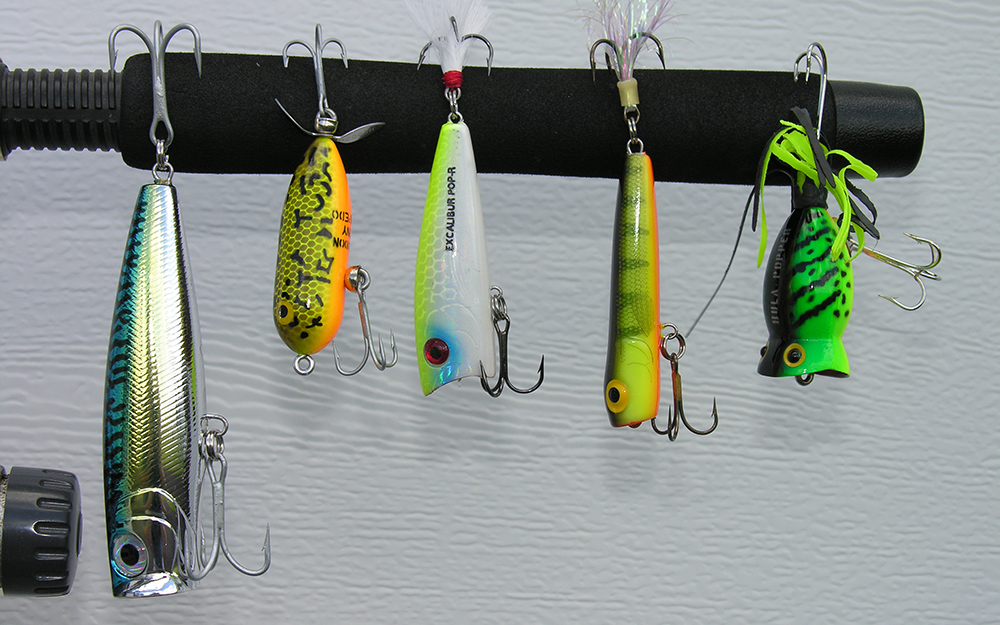 Colorful and noisy are key elements to a productive topwater bass plug. These are proven winners.
(Courtesy of Bill Graves)
Proven top water plugs for gurgle, splash and pop include the Heddon torpedo or spook, Rebel Pop-Rs, Arbogast Jitterbugs and Hula Poppers, and Rapala skitter pops. There are a vast array of colors and choices of a solid or jointed body for additional motion, and some models feature one or two miniature propellers to create greater water disturbance. Several companies offer surface baits in very realistic imitations of frogs, salamanders, crayfish, baby ducks and birds and large insects, which are all excellent food sources for big bass.
Catching smallmouth on a fly rod and floating hair bugs or poppers is a true challenge, but really worth trying. As a devoted fly fisherman, I highly recommend using a 5-weight rod and reel combo with a weight-forward floating line to cast plastic or feather and fur surface poppers for smallies this month. With only a single hook and attached weed guard, it can be a bit tough hooking and landing smallmouth, but oh is the explosive strike and surface-dancing fight on a fly rod worth the effort. Even the ones that don’t hook up or have the hook pull out mid-fight offer some exciting action.
 Sherbey Morris of Fort Kent can be fishing the St John River for smallmouth within 15 minutes of leaving his house, and the action during hot weather is top rate.
(Courtesy of Bill Graves)
If you live in central Aroostook, it will require a bit of driving to reach some smallmouth- filled waterways, but most regional sportsmen are used to traveling for top-rate cast-and-blast outings. The St. John River is the best northern option, with lots of launch sites from Van Buren to Fort Kent to Madawaska and miles of shoreline casting for plentiful bronzebacks.
 Bill Graves drives about 90 minutes from Presque Isle to reach the Penobscot River in Medway, but the bass are plentiful and large and the fishermen sparse.
(Courtesy of Bill Graves)
Bass waters abound in the southern Aroostook area include Mattawamkeag and Pleasant lakes, Crooked Brook flowage, Baskahegan and Wytopitlock lakes and, of course, the Penobscot River in Medway.
Crowding and overfishing is never a problem at any of these locations, and it’s common to boat at least a dozen 1- to 2-pound smallies per outing. A couple of times per trip a big bass of three pounds or more will pounce on a topwater bait, and that’s a tug of war to remember.
Other species may have lockjaw due to low water and hot, sunny days, but the bass are ready and willing. Even youngsters and novice casters will catch fish.