
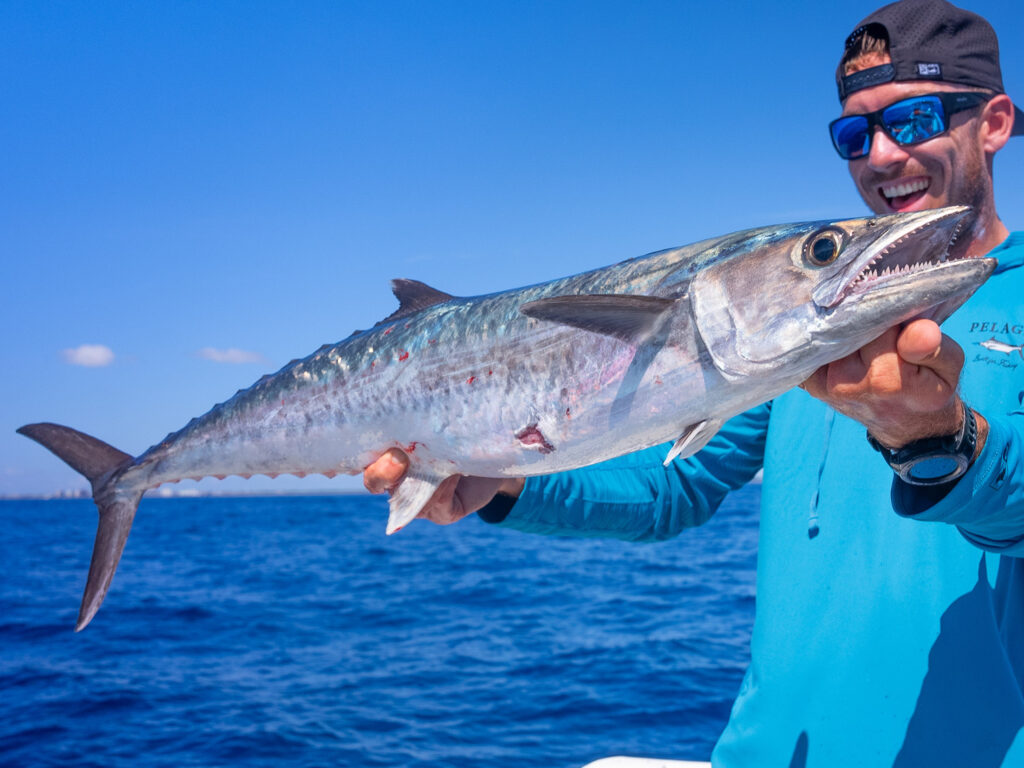
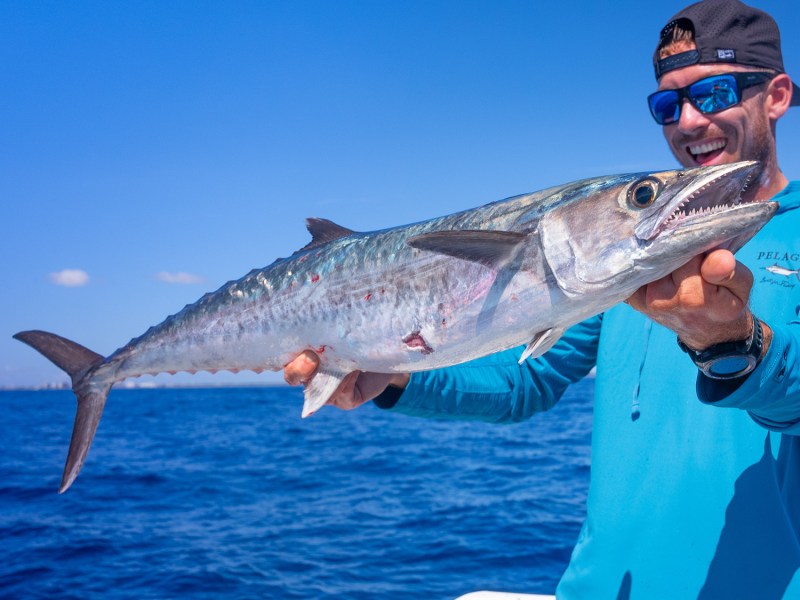
Cooling water temperatures drive king mackerel closer to shore to feed on migrating baitfish.
Colin Gonzalez
Between the summer doldrums and winter lull, the fall migration is the highlight of the fishing year. As water temperatures drop, fish move from warm-water haunts to cold-water hideouts. The fall migration moves fast, and fish don’t linger long, so take our advice to be in the right place at the right time for the best fishing of the season.

False albacore feeding on the surface can lead to fast action when they go on the move in fall.
JASON ARNOLD
New England False Albacore
While most Connecticut anglers are focused on the striped bass migration, a stubborn subculture of devoted anglers worship false albacore. Matt Stone is manager of Black Hall Outfitters in Westbrook, and an evangelist for the miniature tuna. Stone networks with other albacore hunters to locate these fast-moving fish. When schools of albacore show on the surface, Stone races to the location, ready to launch his kayak and chase down fish. He spends a lot of time blind casting small epoxy jigs on light tackle. When Stone gets lucky, the albacore appear on the surface chasing bait. He looks for choppy conditions and cloudy skies to give him an advantage over sharp-sighted and finicky albies. “Last year the albacore were keyed in on smaller baits, so a 5/8-ounce Hogy jig was the ticket,” he says.

There’s a reason kingfish tournaments ramp up around the Southeast in fall.
Chris Kimrey
Kingfish in the Southeast
Fall is tournament season for king mackerel in the Southeast, and Austin Luken of Salty Hooker Fishing Charters in Murrells Inlet, South Carolina, has some advice for the competition. “King mackerel fishing has been tough the last few years,” he says. “The big pieces of structure are covered up with amberjack and barracuda, so I look for small hangs that hold bait without nuisance fish.” Luken says the best shot at a king is offshore over live bottom and ledges in 100 to 120 feet. He starts the day trolling cigar minnows or small ballyhoo on an “old-timer” rig with a jighead and trailer hook. When he locates kings, Luken switches to live bait. “Bluefish and blue runners have been out-catching menhaden,” he says.
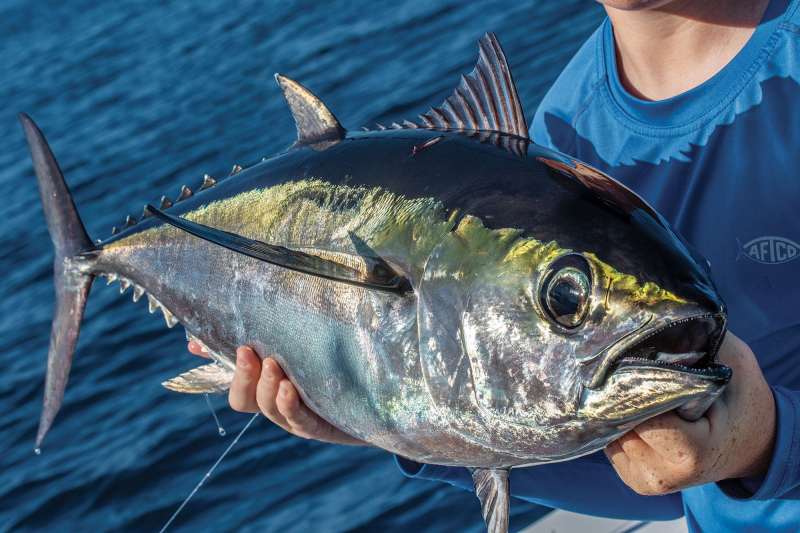
Blackfin tuna move close to shore with cooling water temperatures along Florida’s Emerald Coast.
Adrian E. Gray
Blackfin Tuna on the Florida Panhandle
As water temperatures cool and weather patterns change, blackfin tuna move close enough to shore around Pensacola and Destin, Florida for pier anglers to target. Reporting from Emerald Coast Bait and Tackle in Fort Walton Beach, Alex “Tuna” Turner counts the days until the tuna return. Turner looks for an overcast day with a stiff wind to put the tuna in attack mode. He uses a 5000-size spinning reel with 20-pound braided line and a few feet of 40- to 80-pound monofilament leader to cast YoZuri Crystal Minnows and Rapala X-Raps at tuna on the surface. Last fall, Turner caught three trophy blackfin heavier than 30 pounds.

The yellowtail bite off Southern California is dependent on ocean currents bringing them into the area.
Al Mcglashan
Yellowtail Fishing off Southern California
The forecasted El Nino weather event is on Capt. Tony Vultaggio’s mind. “If we get the El Nino, yellowtail could be happening,” the Santa Barbara captain says. To catch yellowtail, Vultaggio anchors his boat, Loose Cannon, in 90 feet of water around the offshore islands or along the mainland coast and fly lines live sardines and mackerel or yo-yo jigs with Salas Jigs. If the El Nino doesn’t materialize, Vultaggio trolls shallow-diving Rapala plugs for bonito. When he spots bonito feeding on the surface, he casts Krocodile spoons. “When the fishing is good, the bite is wide open and we’re catching 5 to 7-pound bonito at will,” Vultaggio says.