
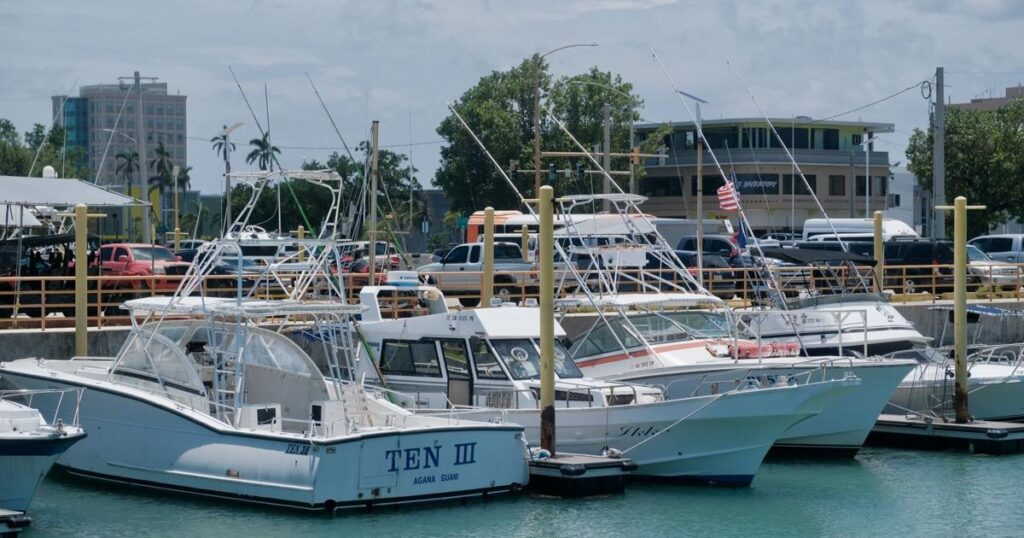
Guam’s boat fishers spent more time trolling in 2025 and still landed 53% less fish, a drop the Western Pacific Regional Fishery Management Council has yet to explain with certainty.
The council’s Status of the Fisheries 2025 report puts the estimated pelagic catch at 326,979 pounds, less than half the average of 700,109 pounds over the past decade. Trolling hours rose 7.4% to 41,518. Active trolling vessels climbed to 466 from 447. Catch rates dropped across most species.
“Fishers had to spend more time and effort to catch the same amount of pelagic fish than in previous years,” the council said in a statement to The Guam Daily Post. Staff at the Guam Division of Aquatic and Wildlife Resources, or DAWR, believe changing ocean conditions, including possible lingering effects of the 2023 and 2024 El Niño, may have altered fish movement. Even so, the council said, “the data do not point to a single cause.”
Another El Niño may be coming. The report notes that ocean surface waters continue to warm around the U.S. Pacific Islands and forecasts a major El Niño event for late 2026.
Commercial pelagic revenue rose to $163,621 from $117,477, though it remains well short of the $255,429 recorded in 2023. The report credits higher fish prices with partly offsetting the lower landings and says fishers reported that trip expenses still exceeded sales returns.
The council’s statement to the Post read the numbers differently. A larger share of the 2025 catch was sold than in 2024, it said, “and not necessarily higher fish prices.” The report does list a 17-cent rise in the inflation-adjusted average price per pound for Guam.
Higher revenue “doesn’t necessarily translate to higher profits and may reflect a greater need to sell catch to make ends meet/recoup fishing trip costs,” the council said. Fuel has made up about 90% of reported fishing expenses over the last four years.
Guam’s bottomfish stock has crossed one line but not another. The report says the complex is no longer overfished and is not experiencing overfishing, but it has not rebuilt. The council’s rebuilding target is 2031.
The council explained the gap with a house analogy. A leaking roof and weak foundation stand in for the overfished zone. The stock has made what the council called “essential repairs” but has not reached the higher level, known as biomass at maximum sustainable yield, that supports the largest long-term harvest without slipping back.
The council recommended raising Guam’s annual catch limit for bottomfish from 31,000 to 34,500 pounds. Estimated 2025 catch fell 6% to 33,896 pounds, about 600 pounds shy of the proposed new limit. It was 36,130 pounds in 2024. The council said the increase rests on long-term catch and effort data in a stock assessment, not on one year’s catch.
Accountability measures are the safeguard. If the most recent three-year average catch exceeds the limit, the next year’s limit shrinks by the overage. If the limit is exceeded twice in four years, the council would reevaluate the measures. National Marine Fisheries Service stock assessments come every three to five years.
The report also shows commercial bottomfish revenue falling 94% to $1,134 even as the number of vessels, commercial and noncommercial, rose to 56. It does not explain the drop.
Sharks remain a sore point. The report lists increasing shark depredation as a common theme among fishers across the U.S. Pacific Islands. At a community meeting the council and the Pacific Islands Fisheries Group hosted in August, a Guam fisher said a deterrent he tried did not work, as the Post reported at the time. Yet the council acknowledged that no dedicated program measures the economic toll of sharks taking fish from Guam boats. DAWR tracks only how many trips experience depredation, by fishing method.
Nor has there been formal research in Guam on commercial deterrents, the council said. Only a few fishers have tried them. Some initially reported success, but as with many commercial deterrents, there is no single “silver bullet.” The council hopes research elsewhere in the United States can eventually be applied in the islands.
The picture in the Commonwealth of the Northern Mariana Islands is murkier. The report estimates the CNMI’s pelagic catch at 78,161 pounds, far below the decade average of 334,101 pounds, but warns that the figure should be read with caution.
How much of that is a real decline is unclear. The decline “may in part reflect missing data rather than an actual change in fishing or fish availability,” the council said, noting that only 34 of 72 planned boat-based survey days were completed in 2025. The report points to funding and staffing constraints at the CNMI Division of Fish and Wildlife. The council said it is working with that division and the fisheries service to fix gaps in survey coverage and data processing.
Other measures also point down. Active commercial fishers numbered 26, down from 87 in 2023, and commercial revenue was $75,926, compared with $443,581 two years earlier. Estimated trolling trips rose 43% to 2,234.
Fishers around Tinian raised concerns about changing buffer requirements and access to traditional fishing grounds near military training, the council said. Military agencies have continued stakeholder meetings and outreach on Tinian, and temporary training restrictions are generally communicated through official notices to mariners. The council said timely, consistent distribution of those notices through the CNMI Division of Fish and Wildlife and other channels fishers use is needed. Its statement did not say whether it will seek formal changes to notification, buffer-zone or enforcement procedures.
Looking ahead, the council said its 2026 priorities include understanding how changing ocean conditions affect fish availability, addressing shark depredation and strengthening territorial data collection, along with better coordination among federal and territorial agencies.