
This column originally appeared in August 2018.
People ask me, “How’s the mahi-mahi fishing, C.J.?” I reply, “It’s one mile per inch.” It seems like lately, if I fish 15 miles offshore, I’ll catch 15-inch mahis. If I fish 20 miles offshore, I’ll catch 20-inch mahis. And if I fish 30-miles offshore, I’ll catch 30-inch mahis. This has actually played out for the past couple of months. I guess it’s a good thing to know that the mahi are out there, even if it might take a little more effort and distance to catch keeper-size fish. (The minimum legal size is 20 inches to the fork of the tail.)
One of the problems my friends and I run into is our tendency to start heading offshore and then getting tempted to stop and troll some lines in water shallower than we had planned. Of course, if there are good fish indicators like solid weed lines, cartwheeling birds or big pieces of debris, there is very little wisdom in passing up these good signs of fish. And, most of the time it pays off with early catches on the way to bigger water.
But sometimes, it just creates distractions and delays. I always try to limit the time I spend in unproductive waters, so I usually set a time limit when I make one of these detours. “Let’s spend 15 minutes here, and if nothing happens, we’ll move on,” I tell my fishing buddies. But, it is very easy to become distracted and sometimes lose sight of the original fishing plan. Even with all this said, there are very few times when a slight deviation ruins a day on the water. As long as I eventually put baits in front of hungry fish, nothing else really matters.
So, when Mike Scott, son Michael and I passed the outer marker at Sombrero Beach the plan was to run 20 miles and start fishing. We ran steadily with no visible signs of fish activity. It was one of those days when there were no birds, no bait, no boats with bent rods, no solid weed formations and no floating pallets or other pieces of debris. The water was very calm, and we easily cruised seaward at a steady 30 knots.
We found some fishy looking water with scattered weeds marking multiple current breaks and a check of the GPS revealed we were 22 miles from shore. We slowed the boat and deployed trolling lines with artificial lures on beaded-chain-rigged ballyhoos. We zigzagged toward deeper water. The weeds thickened and quickly became aggravating. At the 23-mile mark, we hooked a mahi, brought him to the boat and left him in the water. We threw a handful of cut-up ballyhoos in the water and watched for mahi-mahis that we hoped were following our “sleeper.”
We hung out for a while and brought the first fish of the day onboard. He measured 24 inches. “Hey, the one-mile-per-inch rule is true,” we remarked. We struggled with constant weed-snagged lines for a while and decided to look for cleaner water. With all the lines back in the boat we ran several miles farther out. We were in water deeper than 800 feet when we found some big current rips and trolled through them.
Chatter on the radio was not encouraging. We were glad we had put that first fish in the ice box. Undaunted we continued to troll and watch for fouled lines. It was absolutely beautiful out there. We played around with different lures and different tactics trying to raise fish to no avail. Time passed. We were falling into that hypnotic, rhythmic trancelike state that we’ve all experienced.
A big current break, edged with small frothy swirling chop, came into view and we motored over to it. There was a fairly solid weed line on the edge and we followed it for a while. Michael, perched on the bow, called out, “Mahi coming out of the weeds!” Bright-blue living streaks of color invaded the space behind the boat. Immediately, two lines started singing their one-note tune as skyrocketing mahi-mahis strained against screeching drags.
“Fish on, fish on!” we yelled in unison. There’s something indescribable about the moment when hours of trolling, line tending, preparation, patience and perseverance pay off with the sound of screeching reels. The boat explodes with energy and excitement. I live for these moments. I never get tired of it. It’s exquisite bedlam; and I dream about it.
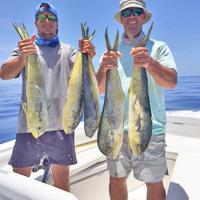
After settling down, we brought two fish to the side of the boat and drew the attention of the rest of the school by pitching pieces of cut bait into the water. We worked that school for a long time. We were picking off perfect eating-size mahi-mahis one at a time. We would drift away from the school and return again to attract them back to the boat. By the time all was said and done, we had ten mahi-mahis nestled beneath a salty slurry of extremely cold ice.
As it turned out, we never found the really big fish we were hoping to run across. But we were overjoyed with the catch we had. We cleaned the boat and fileted the fish. Mike, Michael and I have become frequent fishing buddies over the past few years and just like every other time we have spent time together on the water, we all agreed that life is good in the Florida Keys; life is very good in the Florida Keys.
C.J. Geotis is a lifelong fisherman who followed his dream more than 20 years ago to live in the Florida Keys. His books, “Florida Keys Fish Stories,” and “Double-Edged Sword” are available at Amazon.com. He lives in Marathon with his wife, Loretta, and her Coca-Cola collection. His email is fishstoriescj@comcast.net.