
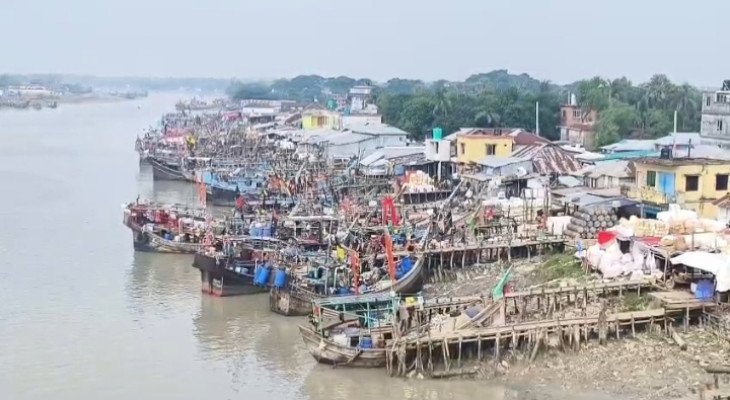
To boost Hilsa breeding, a 22-day ban on catching Hilsa in the sea and rivers adjacent to estuaries begins on Thursday midnight . The government imposed this ban to facilitate the uninterrupted breeding of mother Hilsa. Complying with the government’s directive, fishing trawlers are returning to shore from the deep sea.
Thousands of coastal fishermen—including those from major landing centers like Mohipur-Alipur, Kuakata, and Rangabali in Patuakhali—have already returned. However, there is dissatisfaction among fishermen regarding this new 22-day blockade, coming right after a previous 58-day ban.
Fishermen claim that the Hilsa have not yet developed roe (eggs). They have expressed frustration over the timing of the ban imposed by the Department of Fisheries. Despite this, they have stated they will abide by the government’s decision and refrain from catching Hilsa. However, they are demanding stricter surveillance by the administration and the Navy within the country’s maritime boundaries to prevent encroachment by fishermen from neighboring countries during the ban, as well as an increase in incentive payments and their proper distribution among genuine fishermen.
Nizam Sheikh, former president of the Kuakata ‘Ashar Alo’ Fishermen’s Cooperative Society, said that most fishermen are returning empty-handed from their fishing trips. Fish catches in the sea are no longer what they used to be. Alongside domestic and foreign trawlers, Indian fishermen dominate the waters. While the government takes no initiative to curb these issues, the Department of Fisheries repeatedly imposes blockades that harm the fishermen.
A fisherman named Ali said, “We aren’t catching enough fish in the sea as it is, and now there is this ban.” He added that the incentives provided by the government fall far short of actual needs.
Trawler majhi Md. Sobahan said, “We fishermen are burdened with loans from various NGOs and banks, on top of the debt owed to moneylenders. Everyone involved in the fishing trade is frustrated by this crushing debt.”
Md. Fazlu Gazi, UP Chairman and former president of the Mahipur Fish Wholesalers’ Cooperative Owners’ Association, stated that fish catches in the sea have been poor for the past two or three years; furthermore, whenever a catch seems likely, adverse weather conditions intervene. He emphasized that the Navy and Coast Guard should maintain vigilant patrols in the Bay of Bengal during this ban period, noting that vessels from Myanmar and India often intrude into our territorial waters to fish while the ban is in effect.
Md. Jahirunnabi, the Senior Upazila Fisheries Officer of Kalapara, explained that the breeding season for various marine fish species—including the mother Hilsa—is currently underway, with the aim of boosting Hilsa reproduction. Consequently, a 22-day ban has been imposed to increase marine fishery resources, a measure that ultimately benefits the fishermen.