
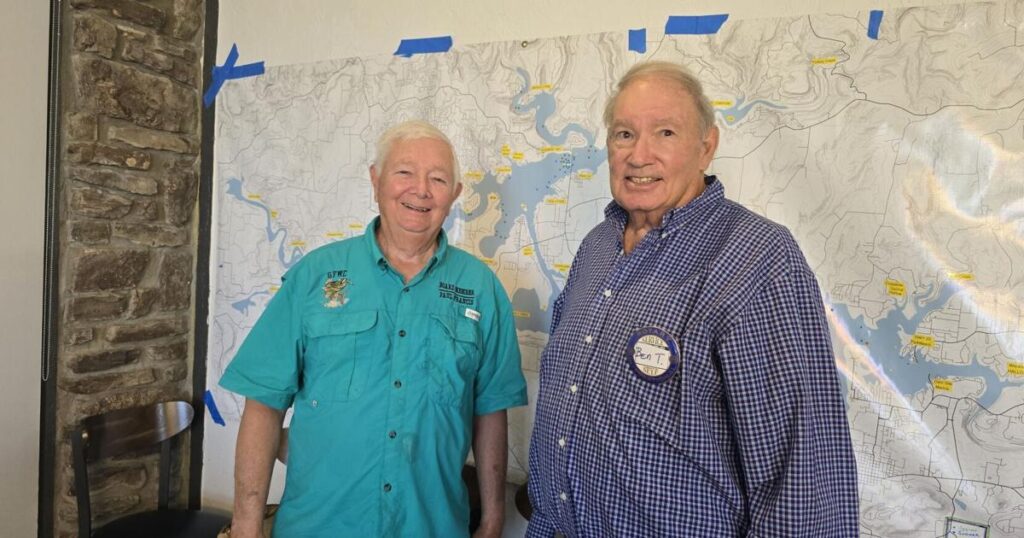
The Fairfield Bay Rotary Club recently welcomed Paul Francis as a guest speaker. Francis, an Army and Navy veteran, retired in 2005 as an aerospace engineer duty officer. In his retirement, he was able to renew his passion for fishing – one that has led him to serve as president of the Greers Ferry Walleye Club.
The Walleye Club, established only a few years ago, has already grown to approximately 400 members. They meet the 4th Monday of each month at the Fairfield Bay Conference Center at 6:30. Membership is only $25/year. The organization is dedicated not only to promoting fishing on Greers Ferry Lake but also to improving the lake’s fishery through conservation, habitat development and cooperation with state and federal agencies.
The club works closely with the Arkansas Game and Fish Commission, the U.S. Army Corps of Engineers and Dr. Lottman, a fisheries management professor. One of its current projects is the installation of artificial fish habitat. Constructed from irrigation pipe, the structures provide protective habitat for young fish, giving fingerlings a better chance to survive and grow.
The club takes care of assembling the structures and coordinating with Game and Fish officials for placement in the lake. Each habitat is GPS-marked, allowing anglers to locate them using the coordinates on major fishing electronics systems, including Humminbird, Garmin and Lowrance.
Greers Ferry Lake covers approximately 65 square miles and has more than 350 miles of shoreline. While walleye is the club’s primary focus, members are interested in the lake’s entire fishery and provide information about several species.
Francis explained that the club has worked to reduce populations of white bass, which compete with walleye for food and can prey on young walleye. The club has held tournaments specifically targeting white bass, with as many as 750 caught in a single day. Striped bass numbers have also been reduced as part of efforts to improve conditions for walleye.
Greers Ferry Lake has seen stocking efforts of one million shad and this year, bluegill are being added as another bait fish to support the lake’s fish population. 75K Black River Walleye fingerlings were also added to the middle fork river and eventually enter the Lake.
One of the club’s most useful resources is a large, color-coded fishing map showing the best fishing locations throughout the four seasons of the year. The map has also been expanded to include the names of coves and points around Greers Ferry Lake, helping boaters and anglers become more familiar with the lake. Smaller versions of the map are available for $35-$50.
Membership in the Walleye Club also includes access to fishing reports filed by other anglers in the club. Non-members can also find fishing information and locations through the club’s website, https://greersferrywalleye.org. The club also shares fishing information with clubs on the Norfolk and Bull Shoals Twin Lakes.
For walleye anglers, the current limit is six fish per person, with no walleye under 16 inches permitted to be retained.
Francis said one of the club’s larger goals is to encourage more year-round use of Greers Ferry Lake. While the lake is heavily used for boating from Memorial Day through Labor Day, activity drops considerably during the remainder of the year. The Walleye Club hopes to help demonstrate that the lake offers excellent recreational opportunities well beyond the traditional summer boating season.
Through habitat improvement, fishery management, fishing information and education, the Fairfield Bay Walleye Club is working to make Greers Ferry Lake an even better destination for anglers while helping protect and improve the resource for future generations.
The Rotary Club appreciates Francis for sharing information about the Walleye Club and the many efforts underway to enhance one of Fairfield Bay’s greatest natural resources – Greers Ferry Lake.