
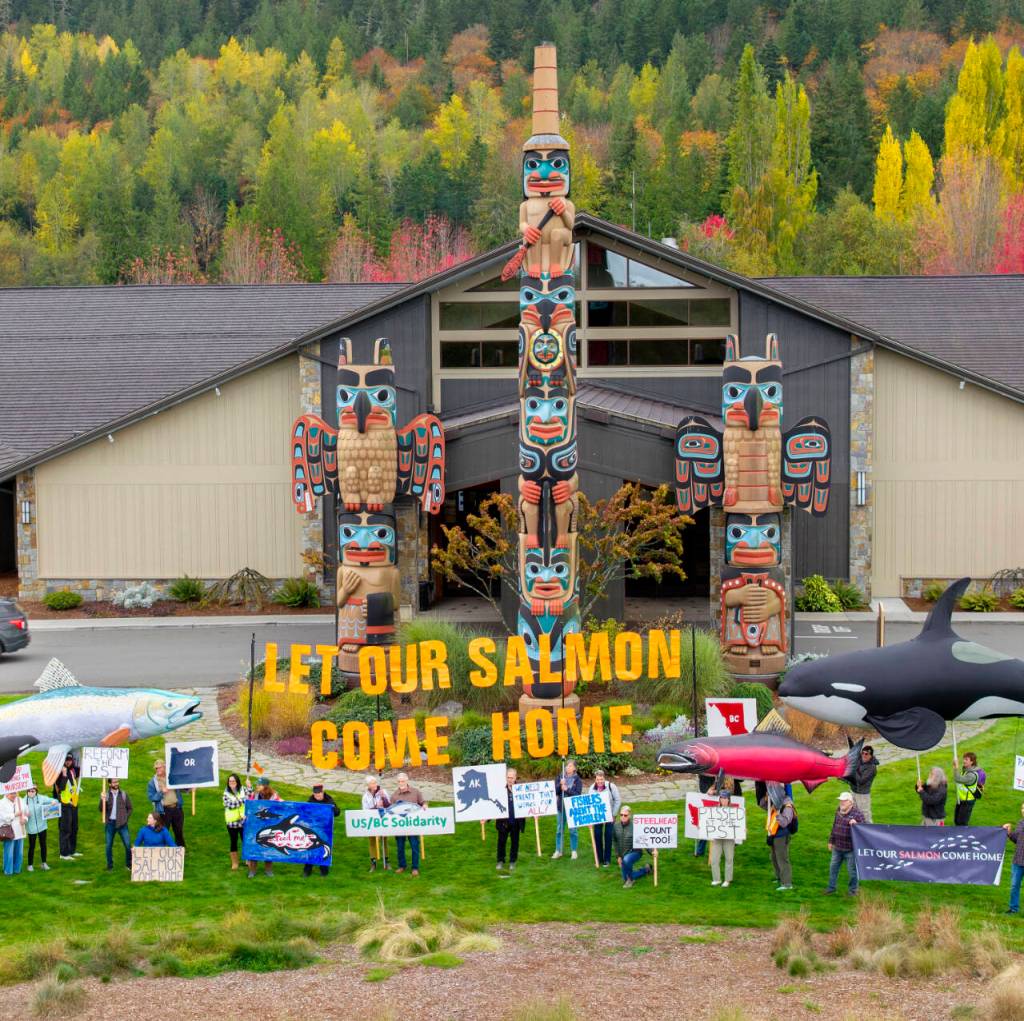
Salmon advocates gather in Sequim to call for reforms to fishing agreements
Published 1:30 am Wednesday, October 28, 2026
Salmon advocates from across the West Coast gathered in Sequim Thursday to call for changes to international fishing agreements they say are allowing too many Chinook salmon to be caught before they can return to their home rivers and reproduce.
The rally and press conference at the Gardiner Community Center organized by Let Our Salmon Come Home coincided with the Pacific Salmon Commission’s fall meeting at 7 Cedars Hotel & Casino.
The 16-person bilateral treaty body is composed of four commissioners and four alternative commissioners each from Canada and the United States. W. Ron Allen, tribal chairman and CEO of the Jamestown S’Klallam Tribe, is one of the commissioners.
The Pacific Salmon Treaty, signed by the United States and Canada in 1985, establishes a framework for conserving salmon and managing fisheries that intercept stocks migrating between the two countries. The current 10-year fishing agreements expire Dec. 31, 2028, and negotiations for the next agreement are scheduled to continue through December 2027, with implementation planned for January 2029.
The treaty itself is not being rewritten. Instead, the countries are renegotiating specific fishing agreements covering harvest sharing, conservation measures and the management of particular salmon stocks.
Speakers at the press conference in Gardiner included Peter Bahls, a fish biologist with the Northwest Watershed Institute in Port Townsend.
“It’s amazing how the focus is all on the habitat, but the fishery management is set aside for the technocrats,” Bahls said.
He pointed to summer chum salmon recovery efforts involving Jimmycomelately Creek, Snow Creek and Salmon Creek in the Jamestown S’Klallam Tribe’s territory as an example of what can be accomplished when habitat restoration and harvest restrictions work together. The summer chum population has rebounded to the point that it could be considered for removal from the federal Endangered Species Act list, Bahls said.
Following the press conference, the organization’s members drove to 7 Cedars to demonstrate with signs and inflatables alongside U.S. Highway 101 before attending the public comment portion of the commission’s meeting, where some of them spoke.
Adrian Tuohy of the Let Our Salmon Come Home campaign urged negotiators to shift fishing activity closer to the rivers and estuaries where salmon originate, allowing fisheries managers to target specific stocks while reducing the interception of fish bound for other watersheds.
“We are asking Pacific Salmon Commission negotiators to lead us toward a more sustainable and equitable future,” Tuohy said in a statement released by the campaign. “By transitioning salmon fisheries closer to the rivers and estuaries where salmon originate and return, we can finally begin addressing the root cause of the interception problem that the treaty was intended to resolve.”
The campaign argues that changes are needed to protect declining salmon populations, endangered southern resident orcas and coastal communities whose economies depend on healthy fisheries.
“We don’t have another 10 years to spare,” Tuohy said. “The time to act is now.”
The Let Our Salmon Come Home campaign says the negotiations offer a critical opportunity to address what it describes as unsustainable ocean fisheries that intercept salmon before they can reach their home waters.
According to the campaign’s press release, Pacific Salmon Commission data show that up to 98% of Chinook harvested in Southeast Alaska’s commercial troll fishery were bound for rivers in Washington, Oregon and British Columbia. The release also says ocean fisheries off Vancouver Island intercept salmon of which 86% are bound for the Lower 48 states.
The implications extend beyond fishing communities to the endangered southern resident orcas in the Pacific Northwest, which depend heavily on Chinook salmon for food. The Let Our Salmon Come Home campaign cited research indicating that changes to ocean fisheries in Alaska and Canada could increase the Chinook available to the whales by as much as 25%.
The campaign is calling for substantial reductions in ocean interceptions, a transition toward more selective fisheries closer to river mouths, and financial support for fishing families affected by changes in fishing practices.
The organization says the goal is to allow more salmon to return to their home watersheds to spawn, supporting future generations of fish, the ecosystems that depend on them and the communities that rely on healthy salmon populations.