

Ice Fishing Jersey Pike
by
Jim Hartobey
Contracting Biologist
December, 2005
The
time has come to start digging out or to purchase some ice fishing gear, as each
cold day increases the likelihood of safe ice and the chance to fish the frozen
lakes and ponds of New Jersey. I look forward to calling friends and scheduling
which days we will hit which pond or lake.
I
recall when a friend of mine first offered to take me ice fishing with him. My
reply was “I don’t ice fish, it’s like fishing in a toilet bowl.” Little
did I realize that I would come to embrace this sport, and look forward to braving
the brutal cold in search of my quarry.
There
is no need to drive out of state since New Jersey has a healthy Pike population
as a result of an aggressive stocking program by the Division of Fish and Wildlife.
New Jersey offers quality pike fishing in some of our better-known lakes, such
as Budd Lake, Farrington Lake, Spruce Run Reservoir, Cranberry Lake, and Pompton
Lake. These lakes have been heavily stocked with thousands of northern pike raised at the Hackettstown State Fish Hatchery over
the years, and the Division uses several of these lakes to collect broodstock.
Northern
pike are easily caught throughout the winter months, and ice fishing is one of
the best ways to target them. I can expect to catch anywhere from 1 to a dozen
in a day’s time on a lake that harbors them. The secret is the right equipment,
location and bait presentation.
Getting
On the Ice
My ice-fishing excursions begin with checking the ice for thickness. However,
anyone who goes out onto a frozen body of water must realize that there is usually
a degree of risk and needs to be aware of conditions. Ice seldom freezes at a
uniform rate, and what constitutes a safe ice is difficult to apply in all cases.
While three inches of ice on a farm pond may pose little danger, that
same three inches on a moving stream or lake with springs, stumps and currents
could be very dangerous. Massachusetts Wildlife has a handy chart to determine
safe ice conditions at www.mass.gov/dfwele/dfw/dfwice.htm.
I
usually do not venture out unless the ice is at least 4 inches thick for safety reasons
and to keep myself alive and dry – I recommend you do the
same. It’s relatively easy to check the thickness: take your auger or spud (basically
a very long-handled chisel for chopping a hole in the ice) and drill about 6 feet
away from the shoreline. Depending on the thickness, you can make the determination
of whether to proceed or move to another location
Equipment
I’ve
found that tip-ups are the best tool for catching pike since it’s mostly a waiting
game. Some anglers do use jigs and other lures, but I always suggest that beginners,
or even experienced ice anglers, stick to tip-ups. New Jersey allows a maximum
of 5 tip-ups per person and they can be purchased in bait and tackle stores
or ordered through a catalog or online.
I
prefer large wooden tip-ups for their strength and durability, spooled with 40
pounds of black dacron line. The thicker dacron line is easier to pull up when
you’ve hooked a fish, and it keeps you from cutting your hands. Pike are not hook
shy, so use a leader on a size 2 or 4 hook. I like to add a rattler about a foot
above the hook to draw in the fish. Rattlers are normally used for rubber worms,
but some have a hole through them to attach a line.
An auger that can drill an 8-inch hole is needed because some pike may be
in excess of 15 pounds – hook into one of them and you will regret buying a 4
or 6-inch borer when you can’t bring up the fish. The extra inches are worth the
investment. Augers are available in gas or hand powered, and both work equally
well. Each type, of course, has advantages and disadvantages.
To haul equipment across the ice, a sled comes in handy. Some anglers build
elaborate sleds, or modify a sled they own, but a simple kid’s sled works wonders
and costs only a few dollars.
Location,
Location, Location!
I know the feeling of walking out onto a lake all pumped up to catch fish and,
seeing the vast expanse of “Frozen Tundra” ahead of me, thinking, “where
should I begin?”. So let’s take the guesswork out of it. Simply look for
any protruding points and start trekking towards that point. Northern pike like
to hang near points, and it also acts as a funneling spot for traveling pike.
Start drilling about 15 feet from the tip of the point. Check the depth and
if it’s deeper than 3 feet, set your first tip-up. Deploy the rest of your tip-up
in 20 to 40 foot increments angling away from the point and checking the depth
in each one. I use a clip-on weight (looks like a bank sinker with clamps) to
determine the water depth. Once your rig (no bait yet) hits bottom, pull the line
up a couple feet then attach a marker (split shot) on the part of the line level
with the water. This gives you a pre-set marker so you do not have to do this
every time you check your bait. Make sure to take the clip-on weight off before
you bait at this point.
To
increase your chances, don’t be too locked in fishing close to shore because Pike
do frequent open waters where there is structure or springs. When you have
a straight line of tip-ups you increase your chance of intercepting pike as they
pass through from one area to another.
Another
great lake feature to utilize is the inflow. Any inflow is a great spot to set
up, but be aware of thinner ice which is typical over moving waters. I usually
fish this area late in the season as pike move to the shallows to spawn. Fish
this area as you would a point.
Bait
Finally
let’s talk bait. Bait can be anything in the form of a fish, and the livelier
the better since lively bait will keep the rattle moving. I tend to use large
golden shiners when targeting trophy-size pike. The only problem with going large
is the increased rate of spit-ups by smaller pike. Smaller pike will grab the large
shiner and start swimming off with it instead of engulfing it, making you set
the hook without luck. When this happens, go small.
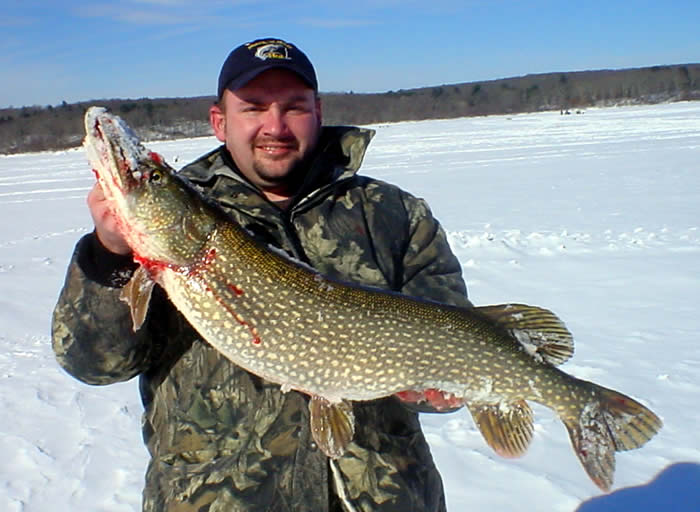
Author Jim Hartobey with his favorite hard-water fish – the northern pike!
Click to enlarge
Bait
can be hard to find during the winter, however you can catch and store your own
bait. Yellow and white perch are easy to catch and can be stored for an extended
period of time in an aerated live well. I’ve kept perch in a garbage can with
an aerator for a month at a time without any problems except for their by-products.
Native
perch tend to swim more on a hook and go berserk when a predator swims near it.
Hook your bait through the body at the base of the dorsal fin and use a split
shot above the leader to help bring down the bait. I usually start at the first
tip-up and bait as I go to the last one. Check the bait every 15 minutes, and
at the same time clear the ice forming in the hole. If your bait appears to be
lively then drop it back down, if not then put a new bait on.
Tip-Up!
When
your flag goes up indicating a fish has taken your bait, take your time and slowly
walk over – most people make the mistake of running to the tip-up sounding like
an elephant and scaring away the fish. Just gently raise the tip-up out of the
hole and get control of the line while letting it continue to spool out freely.
Then set the hook.
The
line is strong enough to pull the pike out of the water. I would not spend more
than 3 hours at a given location if the spot isn’t producing. When that happens,
just pack up and look for another point and head over there.
This
winter, don’t sit around the house wishing for spring. Get the gear ready and
head out to a frozen lake to catch Jersey Pikes. Remember to release those you
do not plan to keep as quickly as possible to ensure that the success of this
fishery continues. If you catch a whopper, feel free to call us at the Lebanon
Fisheries Office at 908-236-2118.
ADDITIONAL
PAGES