
A fading Secwépemc tradition has been preserved thanks to the power of photography.
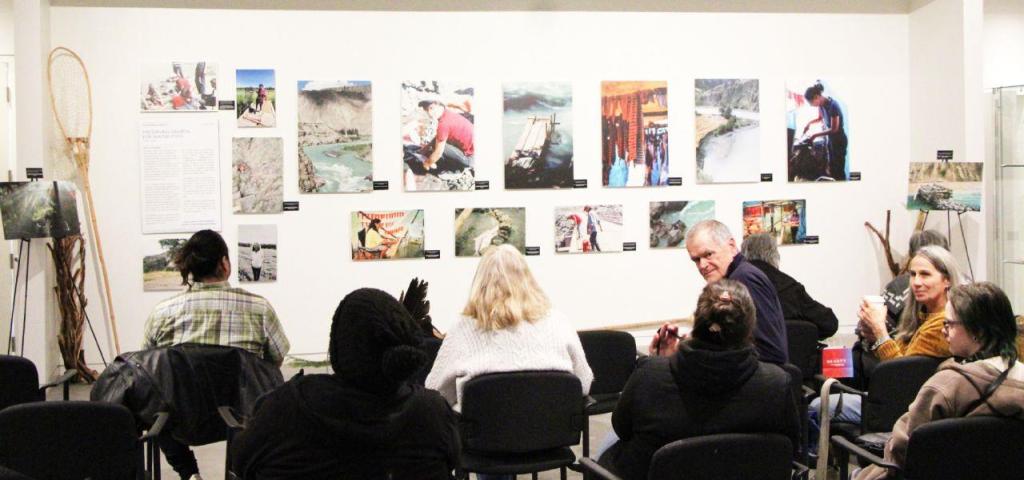
On Thursday, Oct. 29, the Ckultenellcw Cultural Centre hosted the opening of Preserving Salmon For Winter Food, a photo exhibit created by Williams Lake First Nation Elder Helen Sandy. The series of striking photographs chronicles Indigenous fishing camps in Farwell Canyon over the course of 20 years, from salmon being caught using dip nets to being preserved via smoking.
“For me, it’s passing on the knowledge. My two daughters know how (to prepare salmon), my grandchildren know how,” Sandy said. “In our community (salmon) is a delicacy; not too many people have it. It’s a dying tradition, not many people do it anymore.”
Sandy’s journey with photography began when she was 15 and received an Instamatic camera that she used to take pictures of her friends and family. As she grew older and became sober, Sandy became something of an unofficial chronicler for the Sugarcane community, taking photos of powwows, weddings, funerals, community events and everyday life. Over the years, her work was featured at Station House Gallery in Williams Lake several times.
“I just take photographs, I just happen to take nice ones,” Sandy remarked humbly. “To get people in special moments. In the past it was embarrassing moments, but now it’s telling a story. My photographs tell stories. I have over 50 years of photographs in my house.”
Chronicling the salmon harvest was a project she began in 1997 when her friend Velva Tenale invited her to her fishing camp in Tenxlew’s, better known as Farwell Canyon. There, Tenale taught her how to cut salmon in the Lillooet, or Stet’lemc, style.
During her presentation, Sandy wryly recalled that at first she could barely cut 10 salmon a day, while women like Tenale could process 100. She explained that the men would go out early in the morning to fish, and the women and children would gut and clean them. Often they would store the cleaned fish in pools specially built in the river before putting them into the smokehouse.
One of the more striking photos in the exhibit is a piece simply entitled Salmon Lilloeet Style, depicting a large salmon hanging in a smokehouse. Sandy said she cut this salmon herself and was so proud she did it properly that she took a picture of it. In the late 1990s, Salmon Lilloeet Style was entered into the B.C. Festival of Arts in Fort St. John, where it received widespread praise.
“That was something else, you know. When people saw Salmon Lilloeet Style, they said, ‘did you paint that?’ I was like, ‘no it’s a photograph,’ and they were like, ‘it looks like a painting!” Sandy recalled.
Sandy’s exhibit also serves as a eulogy for this tradition, as she knew it. In 2024, a landslide blocked the Fraser River for several days. When the river finally burst through the blockage, the resulting torrent of water washed away 11 of the 14 traditional fishing camps that were established in Farwell Canyon.
This, combined with the Big Bar Landslide in 2019 and other factors, has reduced the salmon population making its way to the Cariboo-Chilcotin. On top of this, many of the people Sandy once fished with have passed away.
With this exhibit, Sandy said her goal is to teach the next generation how fishing and preserving salmon in Farwell Canyon was done. She noted she has already passed this knowledge on to her children and grandchildren, as well as one of her nephews who can now process 100 salmon in a day.
“People need to see all of it. If I bring only one of these photographs and I tell the story, you’re missing a whole bunch of points. This (exhibit) tells it all,” Sandy said.
Sandy’s exhibit marks the first one the Ckultenellcw Cultural Centre has hosted. When asked for her thoughts on this fact, Sandy said it was an amazing feeling and reflected on how far she has come since she was a teenager snapping photos at Sugarcane.
“Come and see something beautiful. Come and experience a day in the life of a First Nations fisherwoman. Come and experience the traditional culture of the Secwépemc people.”
Preserving Salmon For Winter Food will be on display until Nov. 31 at the Ckultenellcw Cultural Centre during its regular hours of operation. This exhibit was made possible thanks to a grant from the First Peoples’ Cultural Council.