
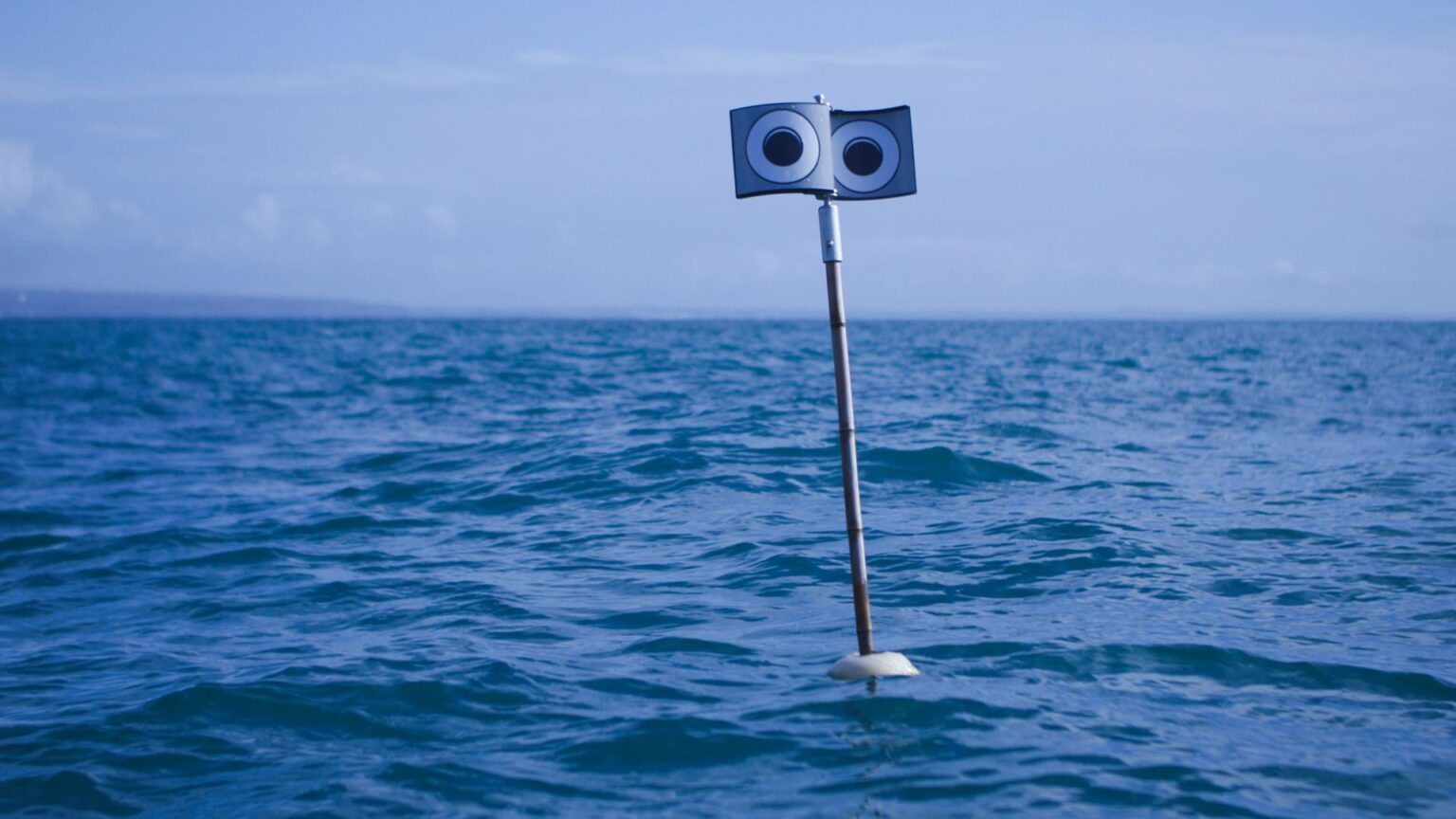
A floating buoy with fake eyes and a bird-of-prey kite cut seabird bycatch in Cornish gillnets, with the biggest gains in winter.
A scarecrow usually stands in a field. During a trial off the coast of southwest England, fishers floated two kinds on the sea instead, and both made their nets much less likely to catch diving seabirds.
One was a buoy topped with a spinning head of large, fake eyes. The other was a kite shaped like a bird of prey. With kites over a net, the odds of it catching any guillemots or razorbills fell by 71%, and with the buoys they fell by 59%.
Until now, evidence that anything keeps diving seabirds out of fishing nets has been limited.
Tom Horton of the University of Exeter led the analysis.
The trial itself was run by Fishtek Marine, a Devon company that makes the buoy, with Cornish fishers who had cameras fitted to their boats.
It covered one stretch of coast and one kind of fishing, so it can’t yet say how the devices would do anywhere else.
Diving birds drown in gillnets
A gillnet is a wall of fine mesh set in the water to catch fish. Seabirds that chase fish underwater, such as guillemots and razorbills, can swim into the same mesh and drown. Fishers call any animal caught by accident bycatch.
Researchers estimated in 2024 that about 31,000 common guillemots die this way each year in European waters alone. Fishers and scientists have tried fixes, from lighting up nets to changing the gear itself.
Even so, the authors describe the tools for protecting seabirds in gillnets as poorly developed.
The buoy came out of eight years of work by Fishtek Marine and the RSPB, Britain’s bird conservation charity.
In Estonia it cut the number of sea ducks nearby, but its record since then has been mixed. A 2023 trial found it didn’t reduce seabird bycatch in Iceland’s lumpfish fishery.
Cameras recorded every haul
The Cornish trial ran from October 2023 to March 2025. Ten fishers took part, all working close to shore, and each one set nets in matched groups.
In each group, one net had kites and another had buoys. A third had nothing. All three went into the same fishing grounds, so they could be compared fairly.
Over that stretch the boats set 1,057 nets, about 80 miles (129 kilometers) of net in all.
A camera system on every boat recorded each haul, and reviewers logged every animal that came up. The fishers were paid for taking part.
Three of the paper’s co-authors work for Fishtek Marine, which manufactures the buoy, and the paper declares that link. The kite is an off-the-shelf product.
Both devices cut the catch
The nets brought up 191 animals that nobody was trying to catch, and most of them were birds.
Guillemots and razorbills alone made up 138. Almost every animal was dead by the time it reached the boat.
The remaining animals included seals and cetaceans, such as dolphins and porpoises.
Both devices lowered the odds that a net would catch any guillemots or razorbills at all, compared with plain nets. On that measure, the kite and the buoy did about equally well.
When birds were caught, nets with buoys held 68% fewer of them for the same amount of fishing. Kite nets held fewer as well, but that gap was too uncertain to rule out chance.
In an interview with Earth.com, Horton said the size of the effect was what stood out. “The clearest surprise was just how strong and consistent the results were,” he said.
Timing and spacing both matter
GPS on each boat logged where along the net every animal turned up, so the team could measure how far each one was from the nearest device. Close in, the kites did better.
Only five birds were caught within about 80 feet (24 meters) of a kite.
Near the buoys, five birds had been caught within about 23 feet (7 meters). The buoys offered moderate protection over a wider area instead.
Where fishers put the devices may be just as important as which one they choose.
Birds can still be caught in the gaps between them, and the authors suggest kites placed every 200 to 260 feet (60 to 80 meters) could suit coastal gillnet fisheries.
Fishers caught the most birds for their effort in January and February.
Fishers targeting sea bass and mackerel caught birds at the highest rates, and so did those using mesh about 4 inches (100 to 110 millimeters) wide.
The authors wrote that deterrents aimed at those winter nets could protect many birds in a way fishers are likely to accept.
Fishers shaped the devices
The fishers generally found the buoys easy to handle and store. The kites performed worse in very light winds and were harder to manage in strong ones.
Setting extra devices along longer nets was the hardest part of the job, and several of the fishers’ suggestions have already gone into new prototypes.
Horton said one of the most encouraging parts of the study was how willing the fishers were to work together on testing new ideas.
“These are simple, low-cost tools that can help address the important issue of seabird bycatch in gillnet fisheries,” he told Earth.com.
Micky Bacon, a fisherman from Mousehole who took part, saw the trial as a chance to show what his industry wants.
“Fishermen don’t just want to go and catch fish, we also want to be part and parcel of improving the environment,” he said.
Questions beyond the trial
Seals are one open question. Fifteen seals turned up in nets with buoys, against six in plain ones. Kite nets held four.
Horton and his colleagues read that as a hint that the buoys might attract seals, and said more testing would be needed to confirm it.
They also noted that the trial spaced its devices to suit the buoy, which probably left gaps for the kites and may have affected the results.
Nor did the team measure water depth or wind, or whether birds stop reacting to the devices over time. Nearly a third of the nets stayed out overnight, and deterrents that birds have to see probably work best in daylight.
Horton said the next step is other waters. “We are keen to explore how these approaches perform in other fisheries and environmental settings, and whether they can be adapted to reduce bycatch more broadly,” he added.
The buoy deterred ducks in Estonia and then made no difference in Iceland, so one good result settles little.
Further trials will show whether these simple devices can protect seabirds across different fisheries, potentially preventing thousands of accidental deaths.
The full study was published in the journal Conservation Letters.
—–
Like what you read? Subscribe to our newsletter for engaging articles, exclusive content, and the latest updates.
Check us out on EarthSnap, a free app brought to you by Eric Ralls and Earth.com.
—–