
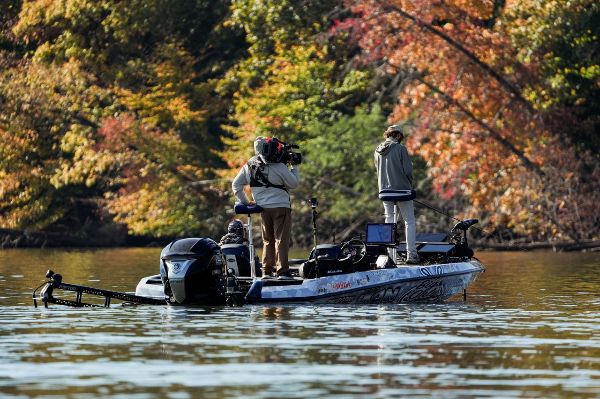
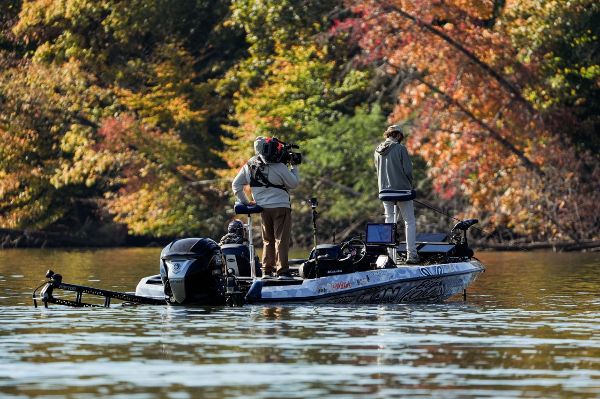
 Fishing in front of a video camera puts extra pressure on bass anglers, but most in “The Champions” tournament at Old Hickory were old pro’s used to it. (WBE)
Matt Robertson’s $1.25 million victory at World Bass Enterprises’ inaugural The Champions tournament on Old Hickory Lake near Nashville put a new mark on professional bass fishing’s record book in terms of cash prizes. It also gave Bassmaster Elite Series anglers something else to celebrate: a convincing victory over their counterparts from Major League Fishing’s Bass Pro Tour.
Of the 15 anglers who advanced to Saturday’s championship round, 10 represented Bassmaster’s Team Stars and five came from MLF’s Team Stripes. Seven of the top 10 were Bassmaster anglers, including Robertson and runner-up Pake South.
That doesn’t settle the long-running debate over which organization has the stronger field, but it’s a pretty good argument for the Elite Series side. The two circuits finally put their leading anglers on the same water, and Bassmaster came out on top.
The 60-professional field was divided evenly between the two organizations, with two amateur anglers added through a fan promotion. After two days of competition, the top 15 advanced to Saturday’s championship. Weights were reset for the final round, making it a one-day shootout among the qualifiers. Bassmaster had already established an advantage during the opening two days, then carried it into the championship.
For years, the split between B.A.S.S. and MLF has left fans wondering how the leading competitors from the two circuits would fare against one another, especially since many who were then stars with Bassmaster chose to leave for the MLF.
The Champions provided an answer, at least for this first meeting. The Elite Series contingent earned the bragging rights.
World Bass Enterprises organizer Brian Bird assembled a $3.25 million purse, with $1.25 million going to Robertson, the largest first-place award in professional bass fishing history. Second place paid $500,000. Those were actual checks, not promotional projections, and they represented an extraordinary payday for anglers who spend much of the year competing for a fraction of that money.
Robertson’s win also came via an inventive approach. He found a concentration of smallmouth below Old Hickory Dam, reaching them by locking through to the Cumberland River below the tailrace. He used a small swimbait on a jighead, drifting it naturally with the current around rocks, shelves and eddies. He discovered the pattern during practice, caught a 20-pound bag on opening day and returned to it when the championship weights were reset.
 Fishing was challenging at the lake near Nashville, but a few of the anglers were able to figure out strategies to weigh in respectable bags. (WBE)
Late October fishing on Old Hickory is no automatic limit factory. Changing current, a large area of water and a mix of largemouth, spotted bass and smallmouth made for a challenging tournament. Robertson’s 20-pound, 2-ounce final-round catch stood well apart from the rest of the field. South finished second with 13 pounds, 7 ounces.
Organizers wanted The Champions to be considerably more than a fishing tournament. They built a week of activities around it, including a large outdoor expo at Gaylord Opryland, concerts, a fan festival at Sanders Ferry Park, opening ceremonies and a celebrity component. The pay-per-view package offered access to tournament coverage and other programming. The idea was to make a professional bass tournament a destination event, attracting people who might not ordinarily spend a day watching a weigh-in.
It’s an ambitious approach, and many of the elements that could make it work were there. A record purse, a cross-tour showdown and a major entertainment program are reasonable ways to get a wider audience interested. The reported crowd at Saturday’s weigh-in was about 4,000, and local television coverage showed some traction in the Nashville market.
The tournament got good coverage in local TV, along with The Tennessean, Outdoor Life, Field & Stream and other outlets. That’s respectable exposure, but not the broad national sports-media attention one might hope for from an event repeatedly described as the Super Bowl of bass fishing.
 Matt Robertson came up with an inventive approach including locking through the dam to win the astounding $1.25 million prize in the event. (WBE)
Several important business questions remain unanswered. How many people purchased the pay-per-view? How many attended the expo, and how many traveled from outside the region? Did sponsors receive the exposure they expected? Those numbers will help determine whether The Champions can become a sustainable annual event.
The communications effort could have been better, to be sure . There was plenty of promotional material about the purse, concerts and entertainment, but less useful information for fishing readers about the competition itself. Who was catching fish? How were patterns developing? How were the two tours matching up? A tournament built around the best anglers in the business should have made the fishing the centerpiece of its daily coverage.
The Champions gave professional bass fishing something it has never had before: a $1.25 million first-place prize and a genuine head-to-head competition between the leading anglers from its two biggest circuits. Robertson supplied a memorable fishing story, and Bassmaster walked away with bragging rights.
Now comes the harder part. Can Brian Bird and World Bass Enterprises turn a spectacular first-year production into an event fans will pay to attend, sponsors will pay to support and anglers will want to fish again? The purse got everybody’s attention. Building a sustainable business around it will be the real test.
– Frank Sargeant, Editor, The Water Wire