
The latest fall weather has been so summer-like that the Dolphin Fleet was able to extend its epic whale watch season by a week before finally hitting pause for the winter. Fishing is pretty much a wrap as well — with bonito being one exception.
Giant bluefin tuna fishing has been hot, but not in the bay the way it usually is in the fall — Stellwagen Bank has been the hot spot. There has been a notable absence of smaller recreational-size bluefin tuna this fall. Striped bass are mostly gone, though they’re providing excellent fall fishing to our south in New York and New Jersey.
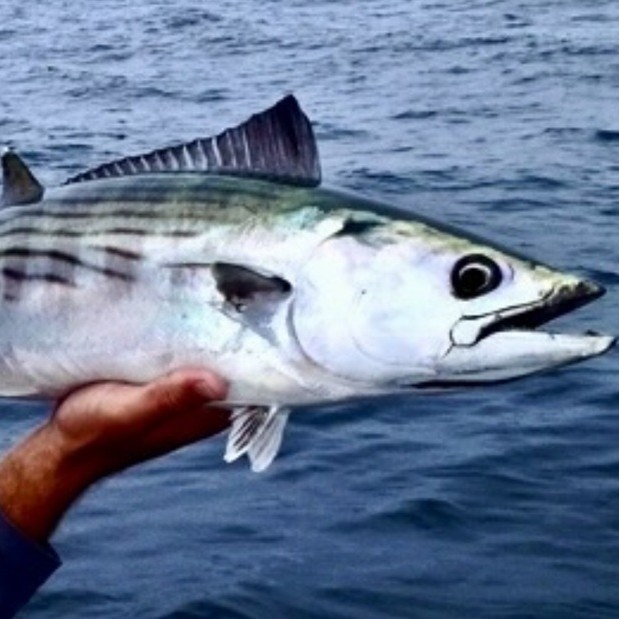
Atlantic bonito have been appearing more often in our waters over the past couple of years in late summer and fall. This year was no exception, and they have become a popular target of recreational fishermen across Cape Cod. What’s not to like? These fish are from the tuna family, put up a great fight, and, if handled correctly (like bluefish, they need to be bled out and iced immediately), they are good eats served raw or put on the grill.
 An Atlantic bonito caught on a CeeJay outing from Provincetown Harbor this week. (Photo by Mike Rathgeber)
Surprisingly, there isn’t a lot we know about this particular fish, but that’s about to change. The Nature Conservancy has started a research project in conjunction with the New England Aquarium as part of a larger coast-wide effort to better understand Atlantic bonito migration patterns. Marine biologists know very little about where these fish go seasonally, how far they migrate, or how connected the different populations may be across East Coast ecosystems.
When they sent a team of researchers offshore in search of Atlantic bonito in September, they caught, tagged, and released 15 fish off the coast of Massachusetts, and each is now carrying a small transmitter, which will help researchers learn exactly where they travel throughout the year.
The data will be collected thanks to acoustic telemetry, essentially an underwater tracking system able to monitor fish movements across hundreds of miles. When a bonito is caught, a small transmitter is implanted, and the fish is quickly released back into the ocean. The tag can now transmit an acoustic signal, or “ping,” that is picked up by receivers strategically placed on the ocean floor from Florida to Canada. When a tagged bonito swims past a receiver, it records the tag number and time — information shared with the project’s national marine research network, so that data collected on a fish tagged here, say, can be studied hundreds of miles away by another research team. As scientists connect these detection dots, they’ll begin mapping migration routes that have never before been documented for this species. Pretty slick stuff.
Atlantic bonito remain unregulated on the East Coast, although the Nature Conservancy has been working with the Mass. Div. of Marine Fisheries to establish precautionary catch limits in Massachusetts waters. North Carolina has also adopted bonito regulations, and several other states are considering regulations as well.
What we need, of course, are regulations that are actually going to do what they’re supposed to do. This project should help by showing where and when bonito move, how long they spend in different regions, and whether fish that are under pressure in one location are the same ones encountered by anglers elsewhere up and down the coast.