

 Khanh Hoa province is resolutely addressing shortcomings and limitations in combating IUU fishing, aiming for transparent, responsible, and sustainable fisheries management.
In particular, the province is focusing on tightening the management of the fishing fleet, promoting the application of technology in monitoring fishing activities and tracing the origin of seafood, and is determined to completely overcome existing shortcomings and limitations.
Strengthen control from fishing ports to the open sea.
At Hon Ro fishing port (Nam Nha Trang ward), reporters observed a bustling flow of boats entering and leaving. As one of the major fishing ports in the South Central region, it attracts a large number of fishing vessels operating in offshore waters. Therefore, awareness campaigns, inspections, and controls against IUU (Illegal, Unreported, and Unregulated) fishing are regularly implemented through coordinated efforts by the Border Guard, Fisheries Surveillance, and the Port Management Board.
At the port, the electronic traceability system for harvested seafood (eCDT) is conveniently located for fishermen to access, look up information, and complete necessary procedures. Tablet computers are equipped at the representative office of the fisheries inspection and control agency, serving to monitor fishing vessels from departure to arrival at port. This contributes to ensuring transparency in the verification, certification, and traceability of harvested seafood products, especially for export goods.
In addition, fishermen are gradually taking the initiative to apply technology, implementing electronic logging of fishing activities after each trip.
As the owner of two offshore fishing vessels, Mr. Duong Teo (Nha Trang ward, Khanh Hoa province) always prioritizes strictly adhering to regulations regarding fishing logbook recording. To ensure complete and accurate information, his family’s fishing vessels simultaneously record logbooks using both electronic devices and notebooks.
According to Mr. Teo, in recent times, fishing activities as well as the use of electronic devices such as VMS and eCDT on his family’s fishing boats have been going smoothly.
 Authorities in Khanh Hoa province are stepping up propaganda and support efforts, while also strengthening inspection and control of fishing vessels before they depart and arrive at ports.
In addition to port-based control, Khanh Hoa province also focuses on monitoring fishing vessel activities at sea. The province has invested in a fishing vessel monitoring system at shore stations with large monitoring screens and assigned officers to be on duty 24/7 to promptly detect and handle any arising situations.
Through this system, authorities can notify fishing vessels when they lose signal from their vessel tracking devices (VMS), warn vessels operating near permitted fishing boundaries at sea; and support search and rescue operations and disaster warnings.
At Hon Ro fishing port, the inspection and control of fishing vessels before departure are also carried out strictly.
Lieutenant Chu Dinh Tai, Head of the Hon Ro Border Guard Control Station, said: “We regularly coordinate with the Hon Ro fishing port representative office to conduct propaganda, inspection, and control of people and vehicles. For vehicles 15 meters or longer, the inspection force checks all factors, especially the tracking device, to ensure it is functioning before allowing them to depart.”
Inspect each fishing vessel and resolve all outstanding issues.
In implementing Directive No. 32-CT/TW of the Party Central Committee on strengthening the Party’s leadership in combating illegal, unreported, and unregulated (IUU) fishing and promoting sustainable development of the fisheries sector, the Ministry of Agriculture and Environment has chaired inter-agency working groups to conduct comprehensive inspections of IUU fishing prevention efforts in Khanh Hoa province.
According to the survey data, the province currently has approximately 5,100 fishing vessels, of which nearly 1,500 are 15 meters or longer, accounting for 28.9%. In the September IUU Index ranking, Khanh Hoa ranked 4th out of 22 provinces and cities with 97.7 points.
However, there are still issues in fleet management that need to be addressed. A review revealed that the province has 460 fishing vessels whose registrations have been cancelled and require monitoring and status assessment; 182 fishing vessels that do not meet operating requirements; and 429 fishing vessels at high risk of violating IUU regulations, requiring thorough monitoring of their mooring locations.
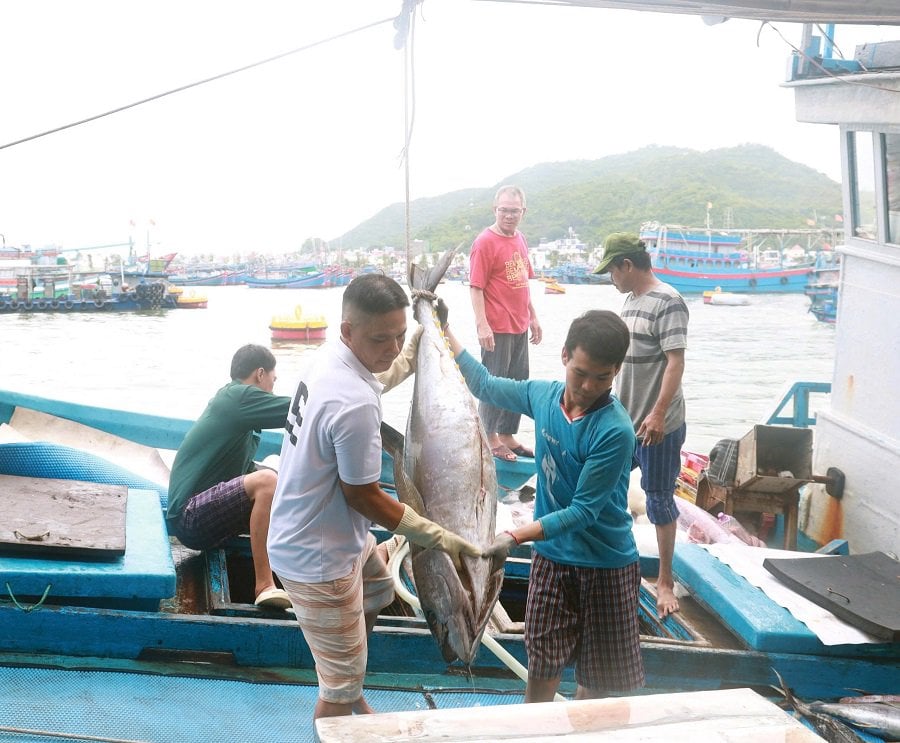 Khanh Hoa province currently has approximately 5,100 fishing vessels, of which nearly 1,500 are 15 meters or longer. According to the September IUU Index ranking, Khanh Hoa is ranked 4th out of 22 provinces and cities.
In light of this situation, Khanh Hoa province is focusing its resources on addressing shortcomings related to fleet management, the national fisheries database (VNFishbase), vessel monitoring systems (VMS), electronic traceability systems for harvested seafood (eCDT), traceability records, and handling of violations. The province is determined to prevent unqualified fishing vessels from leaving port and participating in fishing operations.
According to Mr. Trinh Minh Hoang, Vice Chairman of the People’s Committee of Khanh Hoa province, fishing port management units must proactively review and fully implement the verification process on the eCDT system for fishing vessels that have received unloading and catch monitoring slips.
For vessels whose port arrival information is not yet available in the system, especially those 15 meters or longer, it is necessary to verify and cross-reference the departure and arrival data from the Border Guard, VMS, VNFishbase, fishing logs, and catch records.
In addition, traceability records and certificates (SC) and certifications (CC) must be reviewed in accordance with regulations. If discrepancies are found, they must be checked, processed, and the data updated and standardized; under no circumstances should the origin of seafood be certified without sufficient evidence.
The Chairpersons of the People’s Committees of coastal communes and wards, and localities with fishing vessels, are directly tasked with reviewing each vessel that does not meet operating requirements, vessels at high risk of violating IUU regulations, and vessels whose registration has been deregistered. The identification and verification of mooring locations, actual conditions, and vessel management must be carried out specifically; simultaneously, images, data, and reports must be updated and submitted comprehensively.
By strengthening control from fishing ports to offshore operations, combined with the application of technology and management responsibility at the local level, Khanh Hoa is resolutely overcoming existing shortcomings and limitations in combating IUU fishing, aiming for transparent, responsible, and sustainable fisheries management.