
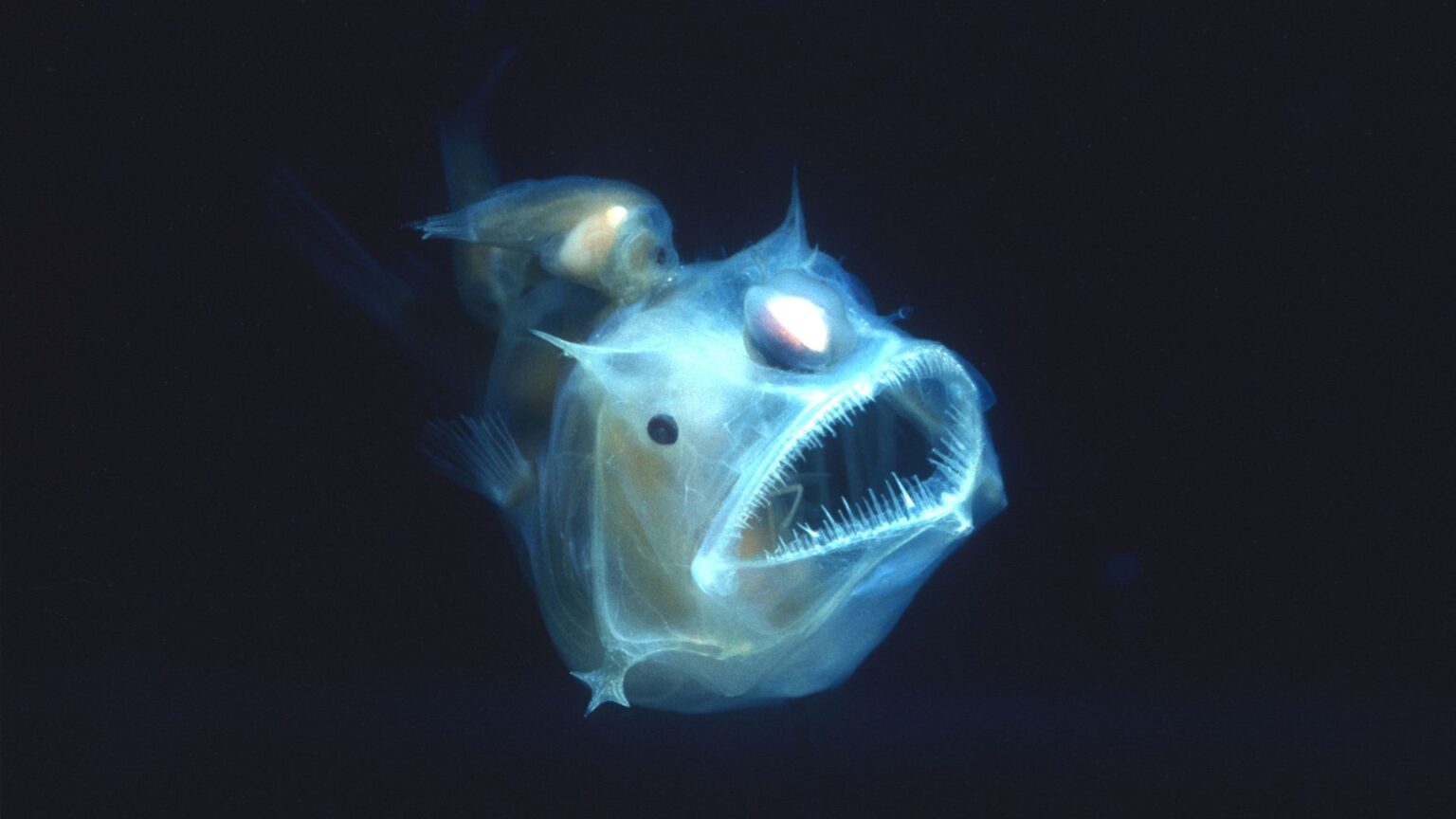
DNA from deep-sea fish and shrimp in the Gulf of Mexico reveals genetic warning signs that population counts alone may miss.
Deep-ocean animal populations have long been assumed to be stable and resilient, partly because their habitats are so vast.
However, a new study of lanternfishes and deep-sea shrimp in the Gulf of Mexico suggests that this assumption may not hold.
In fact, all five species in the study carried genetic signs that conservation guidelines link to a higher risk of extinction. One lanternfish lost about 8% of its genetic diversity in 12 years.
Deep-sea species face risks
Pedro A. Peres, a marine scientist at Florida International University (FIU), led the research.
“This challenges the idea that deep-sea species are naturally more resilient because they occupy such vast environments,” said Peres.
“It shows how much we can miss when we look only at population abundance without considering their genetic diversity and long-term viability.”
Rather than counting animals, the researchers analyzed the DNA of lanternfishes and shrimp caught over more than a decade.
They looked for the measures that conservation scientists use to judge a population’s long-term prospects.
Sampling after an oil spill
The animals were collected through a research program set up after the 2010 Deepwater Horizon disaster. During the spill, 4 million to 4.9 million barrels of oil were released deep below the Gulf’s surface.
The DEEPEND consortium has sampled the Gulf’s open waters ever since. The authors described its dataset as the longest record of its kind for deep-sea fishes, crustaceans, and squid and their relatives.
Crews aboard the research vessel Point Sur used six nets that open and close at set depths. Together, the nets sampled water from the surface down to about 4,900 feet (1,500 meters).
The team picked five of the most numerous animals in the Gulf’s middle depths, which lie about 650 to 3,300 feet (200 to 1,000 meters) below the surface.
Three are lanternfishes (Ceratoscopelus warmingii, Diaphus dumerilii, and Lepidophanes guentheri), and two are shrimp (Phorcosergia grandis and Robustosergia robusta).
After quality checks, DNA from 486 animals collected between 2011 and 2023 went into the final analysis.
Steep population drops had already been recorded in many Gulf animals over the past 15 years (from deep-sea fishes and crustaceans to toothed whales). Still, it wasn’t clear whether the animals’ genetic diversity had fallen too.
A key threshold was missed
A population can contain huge numbers of animals while maintaining far less genetic diversity than those numbers might suggest.
Geneticists estimate its effective population size – a measure of how many individuals effectively contribute genes to future generations – from DNA.
The Kunming-Montreal Global Biodiversity Framework, adopted by nations in Montreal in 2022, suggests using that number to judge the risk of extinction.
Under a widely used rule, a population needs an effective size above 50 to stay viable in the short term (and more than 500 over the long term).
Scientists still debate these cutoffs, and some argue for higher ones. Even so, they remain among the measures that conservation biologists rely on most.
In the Gulf, most estimates for all five species fell below 500. Each species also had estimates near or below 50 in some of the periods that were examined.
The team used three methods, each comparing how common certain gene versions were in different sampling years. All three gave similarly low results.
According to the authors, these genetic guidelines had never been used before to judge extinction risk in any deep-sea species.
One lanternfish lost the most
Co-author Heather Bracken-Grissom is an assistant director of the Coastlines and Oceans Division at FIU’s Institute of Environment.
“Genetic diversity provides the variation populations need to adapt to changing conditions, resist disease and recover from environmental disturbances,” said Bracken-Grissom.
“When that diversity disappears, a species can also lose the ability to withstand future threats.”
The steepest losses were seen in Diaphus dumerilii. Its diversity dropped by about 11% to 13% between 2011 and 2016, depending on the measure.
The same lanternfish then partly recovered, although by 2023 its diversity was still about 8% lower than in 2011. None of the other four species lost that much.
Ceratoscopelus warmingii declined for a while before returning to its 2011 level.
The shrimp Phorcosergia grandis ended 2023 with slightly less diversity than in 2015, and the other two species barely changed.
Losses of a similar size have been recorded in threatened species elsewhere, but over much longer spans of time.
The critically endangered regent honeyeater (a bird), for instance, lost 9% of its genetic diversity between 1919 and the 2010s.
Thus, Diaphus dumerilii lost nearly as much diversity in 12 years as the honeyeater did in more than 90 years. Populations can recover after this kind of loss, the authors wrote.
Did the oil spill matter?
Net catches, sound-based surveys, and the new genetic results all point to population crashes between 2011 and 2015, the authors wrote.
Together, these results suggest that a disturbance may have affected many parts of the ecosystem.
Diaphus dumerilii may have been especially exposed to the oil.
Many lanternfishes travel long distances up and down each day, but this one makes shorter trips, and its adults live near the seafloor.
After the spill, a plume of oil about 250 miles (400 kilometers) long remained in deep water for at least six months before later settling near the ocean floor.
Genetic vulnerability may predate spill
Earlier research also found more contaminants in this lanternfish than in other animals sharing its waters.
However, the researchers couldn’t link the genetic changes directly to the spill, because so little data exists from before it.
Models of each species’ genetic history also estimated that all five had gone through large declines in the past.
The two methods used by the team, though, disagreed on whether those declines were slow or sudden.
“Our results suggest some deep-sea populations may have already been genetically vulnerable before the Deepwater Horizon oil spill,” said Peres.
“This has important implications for understanding the consequences of environmental disturbances. Events such as oil spills may affect populations that already have limited genetic resilience.”
Most species may lose habitat
To look ahead, the team built computer models from records of where each species has been found across the Atlantic. These models linked the records to ocean conditions such as temperature, saltiness, and currents.
The models were then projected to 2050 and 2100 under four climate scenarios, ranging from low to extreme greenhouse gas emissions.
For four of the five species, the models projected a less suitable Gulf. Depending on the species and scenario, the projected loss of suitable area ranged from 5.2% to 70%.
The biggest losses were projected for 2100 under high and extreme emissions.
The shrimp Phorcosergia grandis was the only species whose models pointed to a more suitable Gulf on average, though these models were the least reliable of the five.
The authors urged caution with these projections. Records of deep-sea animals are scarce, and data on conditions at the exact depths where these species live weren’t available.
Instead, conditions at the surface and the seafloor were used.
These animals can travel as much as 3,300 feet (1,000 meters) up and down in a day, so they’re exposed to both, the authors wrote.
Regional mixing is poorly known
In principle, animals arriving from nearby waters could bring back some of the lost genetic diversity. However, few studies have compared these species across regions.
As a result, little is known about how much the Gulf’s populations mix with others.
Changes in inbreeding over the years offer indirect hints. Still, the authors wrote that their reading of those hints should be treated as speculation.
“This study serves as a wake-up call for the scientific community, highlighting the urgent need to integrate genetic monitoring into biodiversity assessments and emphasizing the importance of long-term monitoring to better understand and detect changes in marine populations over time,” Peres said.
Future studies of how these populations connect could show whether animals from elsewhere are replacing some of the lost diversity.
Sampling in the Gulf is still underway, with the DEEPEND surveys funded through at least 2029.
The full study was published in the journal Nature Communications.
—–
Like what you read? Subscribe to our newsletter for engaging articles, exclusive content, and the latest updates.
Check us out on EarthSnap, a free app brought to you by Eric Ralls and Earth.com.
—–