
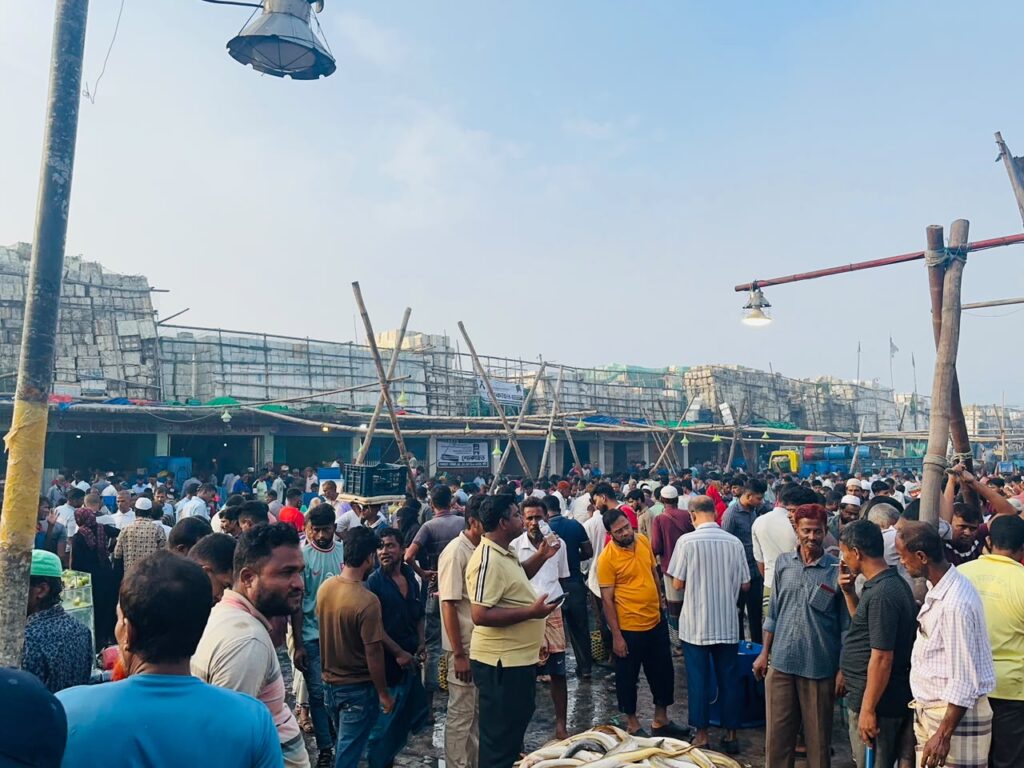
Long before dawn, while the world is still in half-darkness, Chattogram`s Fisheryghat is already alive. Trawlers, boats and mini-trucks loaded with fish arrive one after another and the unloading, bargaining and auctions begin. By daybreak, trade worth Tk 100 crore has already changed hands.
Spread across 3.98 acres between the Chaktai and Rajakhali canals on the Karnaphuli River, Fisheryghat is one of the country`s largest wholesale fish markets. It once dealt only in sea-caught fish, but over the last decade it has also become a hub for farmed fish from across the country. Today it is a central marketplace for fish from the sea, rivers, ponds, and commercial fisheries.
Behind this commercial energy, however, lies the dadon (advance-loan) trap. Dadon is capital advanced to fund fishing trips, covering the costs of trawlers and boats. Depot owners (arats) provide it on one strict condition, all the catch must be sold at their depots.
This system ensnares boat owners and fishermen alike. As a result, most of the profit from the fishermen`s hard labor goes to depot owners and boat owners while the fishermen remain stuck in a cycle of day-laborer existence.
On-site, even before the sky has fully brightened, fish-laden trawlers are already docked at the wharf.
Fish are unloaded in baskets and crates and the air fills with the shouts of laborers, the dragging of baskets, the negotiations of depot owners and the haggling of buyers. Heaps of silvery hilsa, pomfret, barramundi (koral), Indian salmon (lakkhya), Bombay duck (loitta), ribbonfish (chhuri), croaker (poa), anchovy (faishya), mullet (parshe), and tuna lie piled in every corner. Small fish fill baskets beside larger ones, and elsewhere there are mounds of shrimp or mixed catch.
The scene offers a glimpse of the ocean`s abundance.
The trade is not limited to marine catch. Small trucks also bring in farmed fish from ponds and water bodies across the country, including rohu, catla, mrigal, silver carp, pangas, tilapia, and grass carp.
As soon as the fish are unloaded, the wharf springs into action. Workers break up large blocks of ice, haul it from nearby plants, or mix it into baskets of fish for transit.
Ice is in high demand to keep the catch fresh, so many people earn their living producing, transporting, crushing, and distributing it.
Alongside the fish trade itself, the ice trade is a vital part of the wharf`s economy.
Even in the dim early morning, thousands of people crowd the wharf. Retailers from city markets and wholesalers and traders from across the country converge here.
Once purchased, the fish are packed in ice and loaded onto trucks and other vehicles, which carry them to markets in districts throughout the nation.
Fish worth hundreds of crores of taka are traded here daily, and many merchants` profits and losses depend on supply, demand, and price.
At the heart of this enterprise is a financial system built on dadon (advance credit), centered on the wharf`s 103 gadi (wholesale depots).
Anwar Hossain, former president of the Old Fisheryghat Traders` Association, told BSS that these 103 depots, locally called “godis,” are allocated to members of the Sonali Mechanized Fishermen`s Cooperative Society. Depot owners each oversee multiple boats or trawlers and a core part of their business is giving them dadon before they sail.
The advance covers fuel, food, provisions, and other deep-sea fishing costs, but it comes with a condition: on returning, the catch must be sold only at the depot that provided the money. Boat and trawler owners who accept dadon cannot sell their fish elsewhere.
Mohammad Selim, proprietor of Messrs Shah Omar Trading at Fishery Ghat, told BSS, “Each depot advances capital to the boats, which must be recovered over the fishing season. Across the 103 depots, the advances exceed Tk 100 crore and the daily fish trade here reaches the same figure. It is this investment that keeps the fish supply flowing.”
Abul Hossain, proprietor of Abul Hossain Saudagar Trading, said boat owners often cannot cover the costs of a fishing trip alone. “Funds are advanced and later settled through the sale of the catch. But fish at sea are not always available, so these investments carry risk,” he added.
A boat owner said “We can`t always run a boat on our own capital, so we rely on advances. If the catch is good, we make a profit after expenses. If it`s small, even fuel costs are hard to cover.”
Fishermen are the backbone of this multi-crore trade. They spend days at sea, facing bad weather and rough waves, in work that is both grueling and dangerous. Yet most are neither boat owners nor business partners. They are daily wage laborers on a fixed rate, he added.
A good catch raises profits for owners and traders, while a poor one risks losses. For fishermen, nothing changes: their pay is not tied to the catch or sales. During fishing bans, or when boats cannot go out, their work stops entirely.
“Fishing is our ancestral profession; it is how we survive,” said Sagar Jaldas. “Whether the catch is large or small, our wages remain the same.”
Another fisherman described the bans- “When fishing is prohibited, we have no work and must borrow to run our households. The government now gives rice and cash assistance, which eases some of the hardship.”
The current Fishery Ghat stands on land leveled for capital dredging by the Chattogram Port Authority in 2014. It is alleged that members of the then Awami Matsyajibi League, the Awami League`s fishing-related wing, illegally seized the site under the banner of the “Sonali Jantrik Matsyajibi Samabaya Samity” and set up a fish market there. It is further claimed that the site was later leased from the Port Authority for 15 years under the name of the “Jatiya Matsyajibi Samabaya”.
The River Protection Commission and the district administration have identified the site of the “Notun Fishery Ghat” (New Fishery Ghat) as part of the Karnaphuli River. It is also on the list of illegal structures encroaching on the river`s banks. The High Court has issued several rulings and observations calling for the market`s eviction. Yet, for reasons that remain unclear, it has not been removed.
During a visit to the site, a man who gave his name as Atik Majhi approached the journalist. He said: “This is part of the Karnaphuli River, and some of the land belongs to a Waqf estate. Beyond that, the market has no legal standing at all. It is completely illegitimate. Associates of the former fascist regime are still illegally taking lakhs of taka from here and using the money for anti-government activities.”
Salma Begum, the District Fisheries Officer of Chattogram, told BSS that Notun Fishery Ghat is the largest fish market in Chattogram. “It is always busy, and fish worth hundreds of crores of taka is traded here every day,” she said.
On dadon (informal, high-interest lending to fishermen), she said her office had received no complaints. Such arrangements, she added, usually come from mutual understandings between the parties involved. She also said no complaints about the legality of the land or its lease status had been filed with her office.
She noted that Fisheries Department officials inspect the market regularly. “Under the Fish Inspection and Quality Control Act, 1997, they monitor fish quality, make sure the products sold are safe and free from adulteration and check for illegal trading,” she explained.