
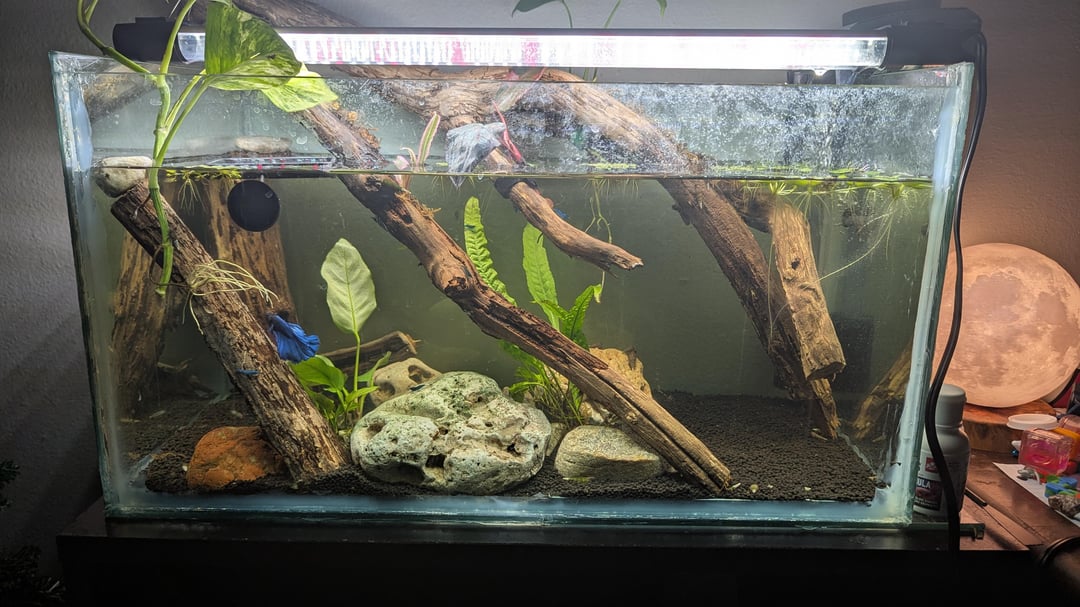
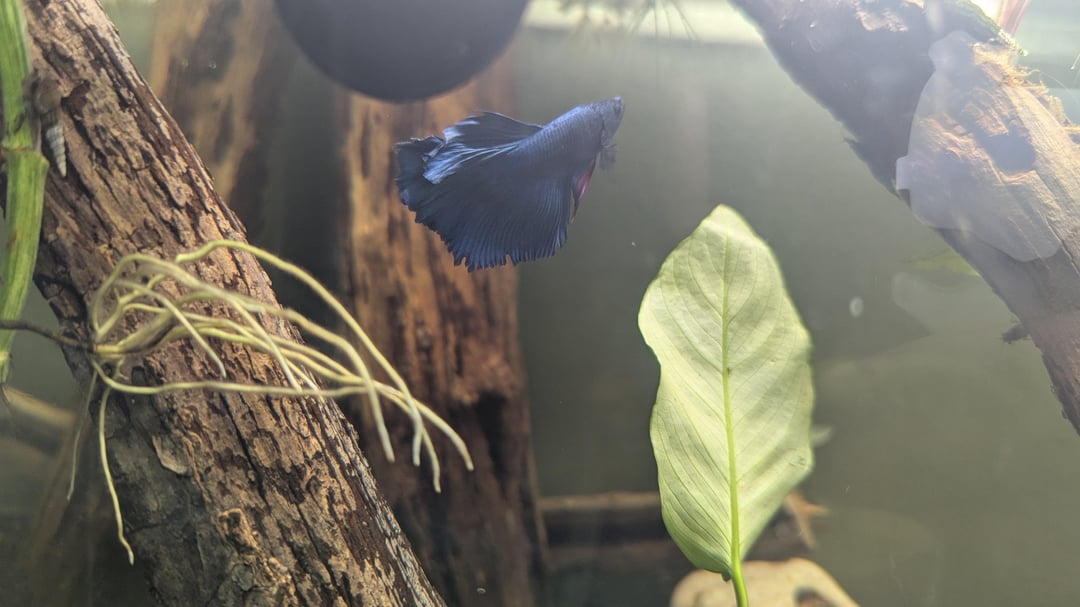
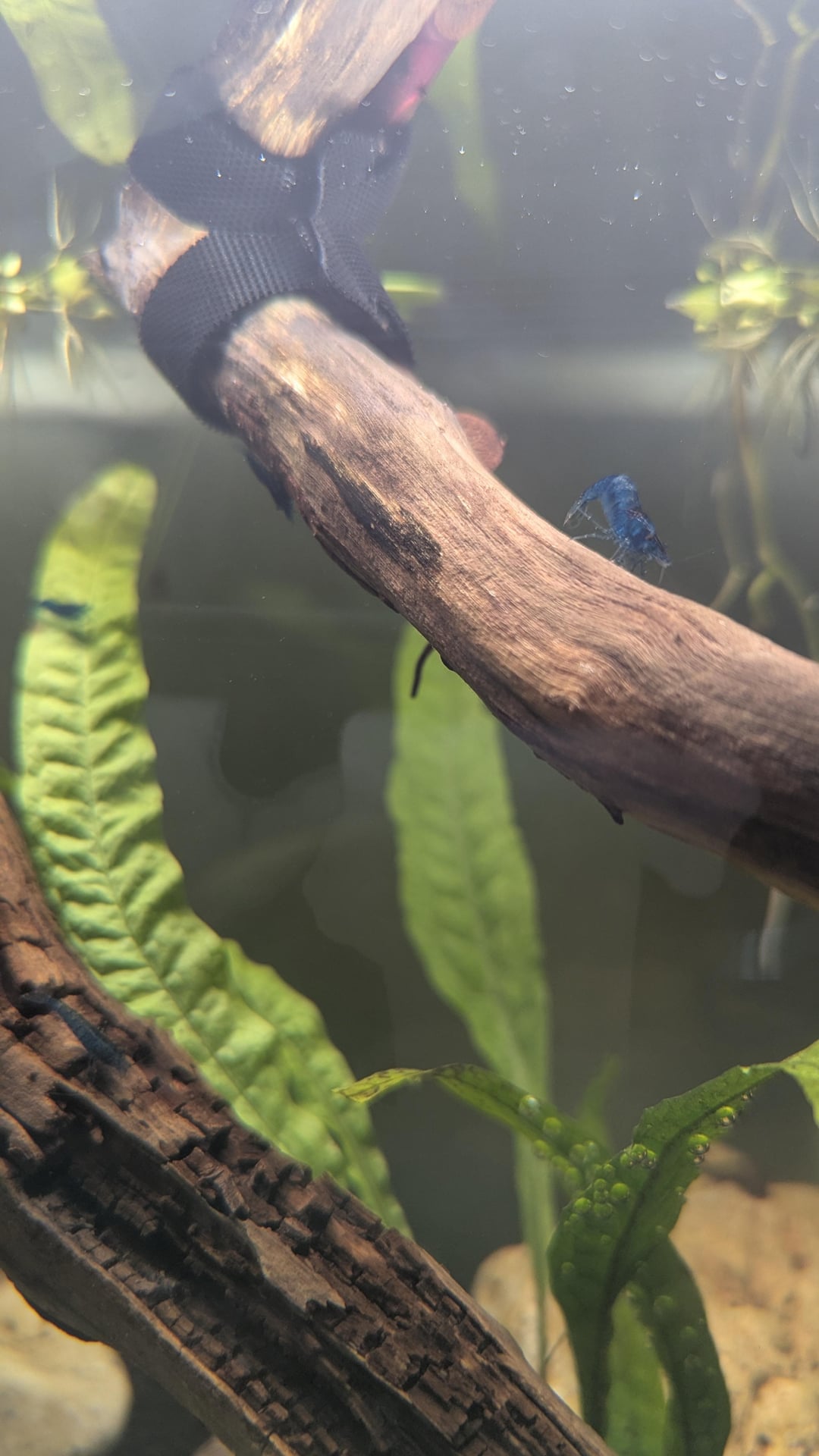
Built this ~10g tank out of scrap glass for my 10yo, she's only with us part time so I'm the primary caretaker of it's residents, just looking for some help making sure everything is as it should be and we're not missing anything. I have some experience with terrariums but this is our first attempt at an aquarium.
Please feel free to nitpick, we're doing this all on a pretty tight budget but we still need to know where to improve
- Fluval AC30 filter on it that's set to minimum flow
- Fluval stratum substrate
- Wood and rocks sourced from the outdoors, baked the wood to disinfect and then submerged in a bathtub for a couple weeks before adding
- Fish-in cycling because I didn't realize stratum needed to leech ammonia for a while first
- neocaridina shrimp and trumpet snails
- added beneficial bacteria booster initially and at every water change
- some misc houseplant cuttings attached to the wood above the water, frogbit and salvinia floating on the surface
- light is just sitting on the top, waiting on the mounting hardware to hang it ~6" above where it is right now
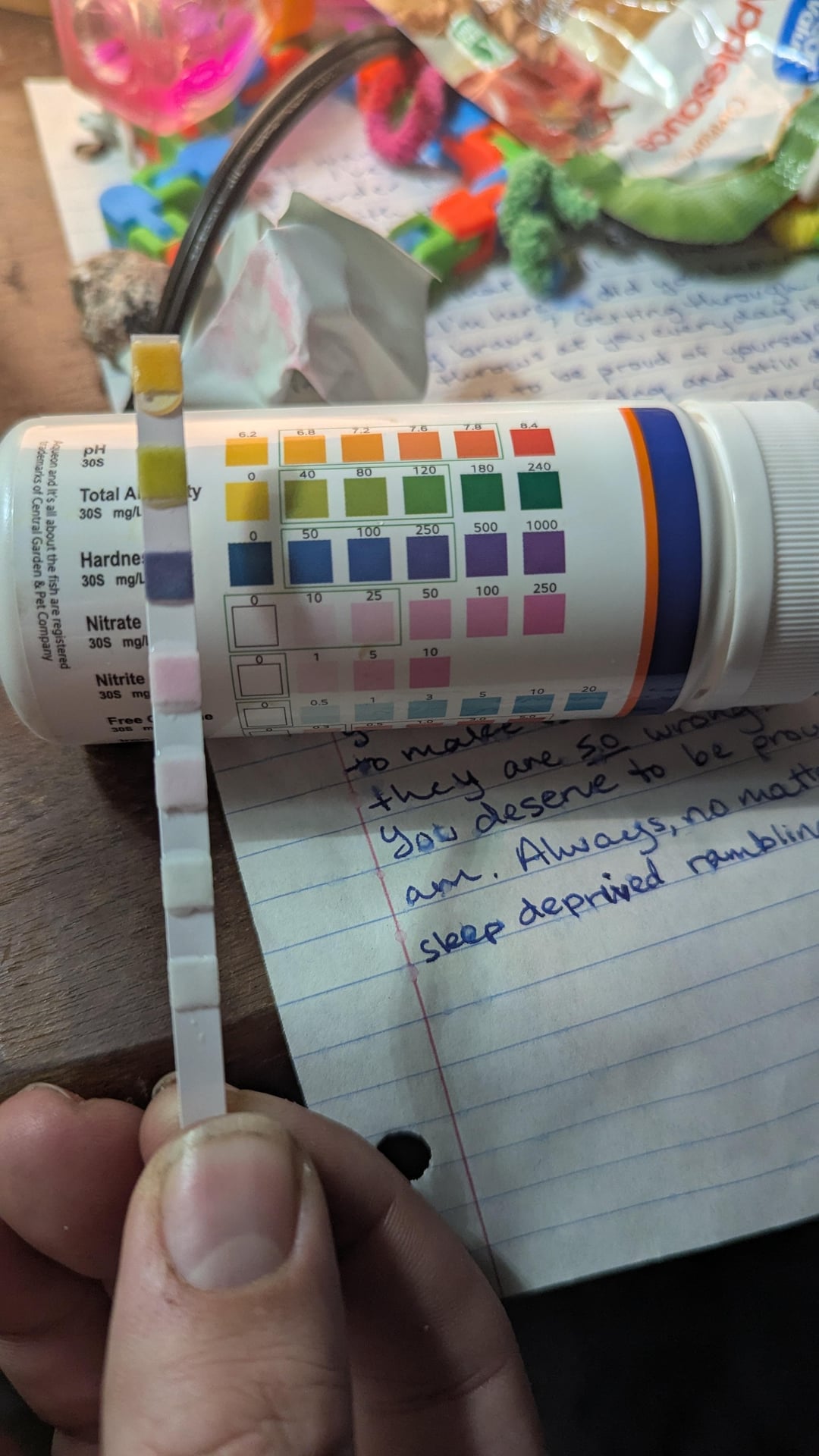
- water test is ~6hrs after a ~40% water change
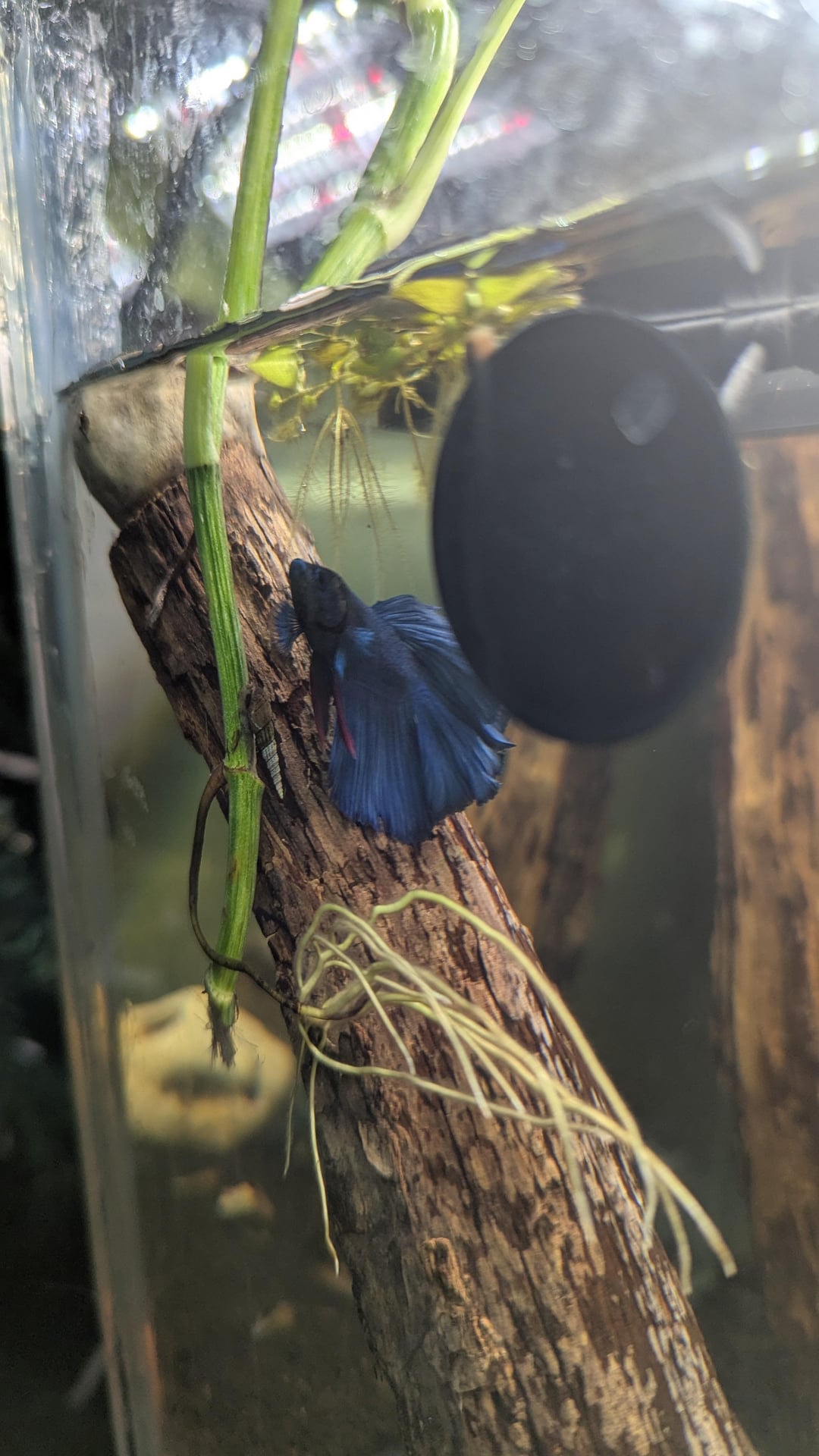
Please help me not kill this fish
https://www.reddit.com/gallery/1oq3dn0
Posted by 3stanbk
4 Comments
What a beautiful betta! 🥰
I would suggest getting the API freshwater master test kit as they are more accurate than the strips.
I can’t see the hammock here for the betta but it would be good if he/she has one to rest on.
NO2 is a bit high, so probably do 10% – 20% water change everyday until it’s 0. If there’s still ammonia while fish-in-cycle, you can add a bit of seachem prime directly in the tank as it binds ammonia for 24 – 48 hours to help your beneficial bacteria to catch up. I can attest to this as i had a 0.25 ppm spike after rescape and trimming dead moss and a few hours seachem (and/beneficial bacteria), my ammonia went down to 0 ppm.
Water seems a bit hard (i have this issue too it is so difficult to soften 😭), so probably a bunch more catappa leaves to help =)
https://preview.redd.it/hts8nwawynzf1.jpeg?width=1080&format=pjpg&auto=webp&s=0273c745f4593784e50c103e6059c05354c985e4
Seachem Prime does not “bind ammonia”, do not rely on it for that, no chemical mechanism for how it would possibly do that has ever been given by Seachem. It’s great for dechlorinating water (“conditioning”), which is definitely very important, but that’s it.
What you have going both for and against you is your pH, which is quite low, that is to say it’s quite acidic. On the one hand, this is good for decreasing the toxicity of ammonia, which is heavily pH dependent. The lower your water pH, the higher the needed concentration to become toxic to the fish.
The downside to a low pH is that it makes cycling take much longer. It will still happen, but the necessary bacteria just take much longer to replicate in acidic conditions. The biggest danger here is that the first part of your cycle will become established–bacteria converting ammonia/ammonium to nitrite–but that the second part–different set of bacteria converting nitrite to nitrates–will take longer. Nitrite is the most toxic of the three. Aquarium salt can lessen the toxicity of nitrite to fish, which is why nitrite is not such a concern in saltwater tanks. If you see any nitrite at all, I would suggest doing a large water change immediately, and then dosing the tank with a sustainable amount of aquarium salt.
Second getting the API freshwater liquid testing kit. You will want this for testing ammonia and nitrite. I don’t worry overmuch about nitrates; they simply are not that toxic until very high levels, which you will be diluting constantly to try and keep your ammonia/nitrite levels low anyway, and the plants will take up the nitrates also.
Here’s the most important thing nobody is going to tell you: Once you get past the initial startup phase (cycling), if anything is going to kill your fish before old age, it is most likely going to be a bacterial infection. Not from nitrogen cycle bacteria (autotrophic), they’re pretty harmless. I’m talking about heterotrophic bacteria. They are everywhere, and most can’t make your fish sick *unless there’s a really large number of them*. Keeping your fish healthy long term is about keeping the population of heterotrophic bacteria in the water down. One of the main ways to keep them out of the water is to have a lot of them in the filter. More heterotrophic bacteria in the filter means fewer in the water, because they compete for food.
Live plants remove inorganic nitrogen from the water, but live plants are a source of organic waste which feeds bacteria. A planted tank often needs MORE biofiltration, not less. There are exceptions but as a novice entrusted with your kid’s fish, you don’t want to gamble on whether you are set up to be one of the exceptions.
You have a pretty decent filter, which is nine tenths of the battle. If you don’t already have one, get a foam prefilter for the intake. It’ll keep their fins from getting sucked in, it’ll add extra biofiltration (foam is the best biofiltration medium, no matter what fluval or seachem says), and it’ll reduce cleaning frequency on the main filter sponge. Get (or make!) the largest foam prefilter you possibly can. The bigger it is the less often you’ll have to clean it (or anything).
Try to avoid cleaning ANY part of the filter unless it actually becomes clogged. Brown gunk in your filter is a GOOD thing. That gunk is your sword and shield in the fight against bacterial infections.
You can stop adding the “bacteria booster”. In not convinced those do anything, but if they DO do anything it’s a one time thing, not a “every water change” thing. Don’t trust anything you read on product labels.
Try to keep too much organic crud from building up in/on the substrate. That crud is slow-release food for heterotrophic bacteria.
You can’t test for those bacteria, but you CAN tell if you have a problem by looking at water clarity. Large numbers of bacteria in the water make it look hazy. Multiple things can cloud the water, so cloudy water doesn’t always mean there is a problem, but *persistent* cloudy water should always be treated as a serious problem. Having *crystal* clear water is the only way to be sure your water is low in bacteria.
Keeping the temperature a bit lower than usually recommended may also help prevent early death. I recently did a poll on whether betta keepers kept their bettas at 77F or above, or below 77F, and what the typical lifespans of their bettas were. Those that kept their bettas below 77F were twice as likely to report their bettas lived at least 2 years (78%, vs 39% for the “at or above 77” group), and 5 times more likely to report their bettas lived over 4 years (37%, vs 7% for the 77 and up group).
I hope whoever wrote that note is feeling better ♥️