
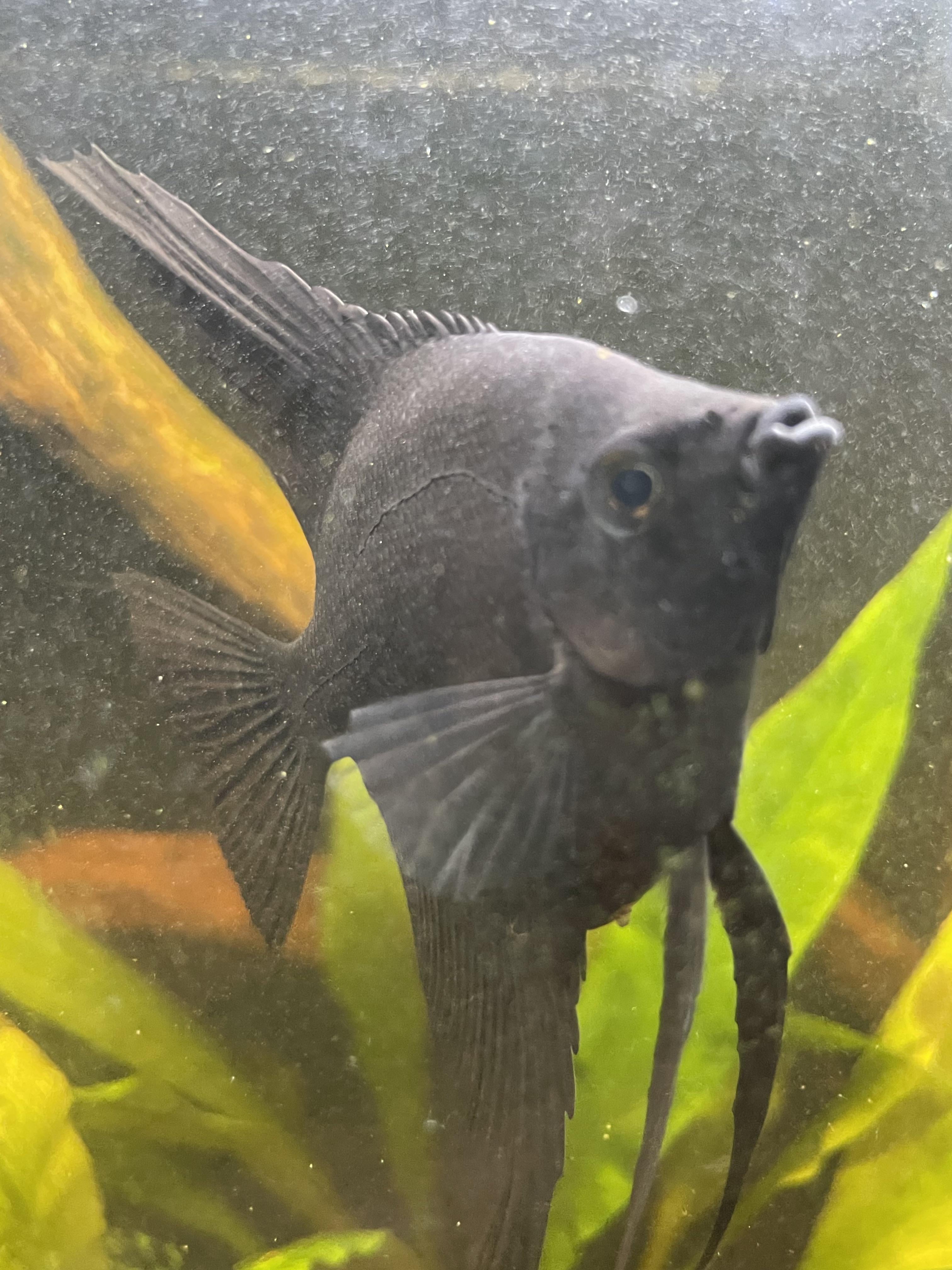
I left town for the weekend (Friday-Sunday), and when I got back Sunday night I discovered there had been a power outage. Unfortunately, none of the filters on my three tanks were running. About half of the filter media was dry, and I have no idea how long the power was out. On the bright side, I didn’t feed the fish before leaving.
As soon as I noticed, I did a 50% water change on all three tanks and tested the water. Only one tank (a 35-gallon) showed any issues, with ammonia at 0.25 ppm. I cleaned off surface gunk and added bottled nitrifying bacteria. The next day it was reading 0.25 ppm or maybe slightly less, with nitrates around 0.50 ppm. So far all the fish are acting normal, but I’m planning to do an even larger water change today.
(Stock: two juvenile angelfish, two gold gourami, and five garra rufa)
I haven’t fed the fish since Friday, and they are very eager for food now. I’ll give them a small amount today, but I’m wondering: how long can fish safely go without eating in a situation like this?
One more thing… The water in that tank looks kind of dusty/cloudy, especially compared to my other tanks which are somehow crystal clear. My guess is a bacterial bloom from the filter shutdown. Does that sound right? Would it help to temporarily add a spare filter with a fine sponge to catch some of that bacteria, or should I just let it resolve on its own?
Any advice is appreciated!
Posted by Several_Ad3321
2 Comments
You’re responding appropriately with the water changes. I’d go ahead and feed, then keep with the water changes maybe once or twice more as parameters dictate. Unfortunately, I once had a filter lose prime in an outage then burn up. I assume it was about 3 days but like you, I got out the test kit and kept on the water changes until things balanced. The good news is your fish are okay so no need to stress.
Don’t worry too much. Let your filters run and feed very minimally. The cloudiness is probably a bacterial bloom and it will repopulate your filter media and you’ll have clear water in no time. Test your water quality to make sure, watch that your ph doesn’t change too much or get too cold, both of which will inhibit the colonization of the bacteria. This has happened to me a few times with no issues.