
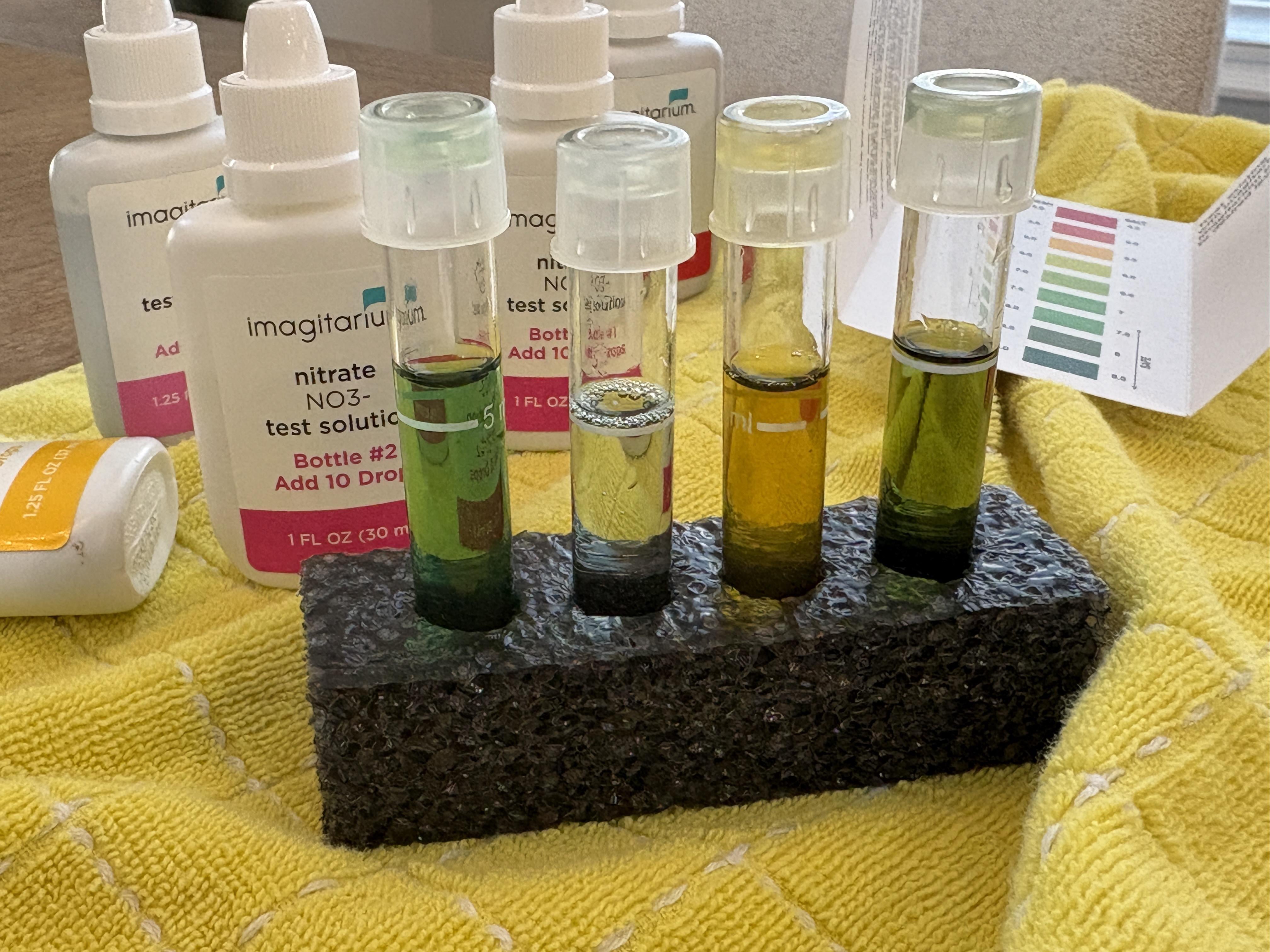
In 2-3 weeks I will have had this 20 gallon tank for a year, and every time I test it it’s been these exact parameters. As you can see from my post history, they look identical to the parameters I measured before the 90% water change. Even the pH is the same even though my tap water is neutral and I added a buffer. I’m really just completely lost on this issue because I haven’t seen anyone else with these issues to such an extent. Like I’ve seen 6 months at most but never a year. All bottled bacteria have failed me and I have no source of established filter media
Posted by Random_Axolotl_
21 Comments
What do you have in the tank right now Fish and Plant wise, and what are you dosing with.
Have you tried a different test kit? You can ask a fish store to test your water, maybe its the test kit? I seeyoure ysing imagitarium, i dont know how well that one is but i doubt itd cause such severe issues. I use and like api freshwater master testkit, but for the purposes of this experiment you can ask a fish store to test your water for free lol. If its the same then its your water. If not then its the kit
If the results are exactly the same before and after a 90% water change, then either your tap water **really sucks** or your test has gone bad.
Imagitarium makes terrible products. I like their black sand but that’s it.
Your bottles should have expiry dates on them!
Hey! I was having a problem where the ammonia was reading higher because my bottles had leftover residue. After soaking the bottles in hot water they were okay. I actually can’t tell which is which test for you. However I would suggest cleaning f the bottles or trying a second test kit because this could be a bust. I use the API.
If the water is truly messed up empty the whole thing. Rinse your decor and whatnot. Add new water and add conditioner and API quick start per instructions.
Might just need a complete redo.
I’m looking at 4 vial of colored fluids and no details of what they are.
If pH is neutral, why are you messing with it? ‘Buffer’ is just baking soda, which will raise pH. Why?
As others have said, test kit likely the issue. Take your water to an aquarium for testing (in a clean container or similar).
Also do you have rocks in your tank? Some rocks can alter pH and leach unwanted minerals into the tank which can throw things out of whack
You’ve set your post history to private. Can you tell us the numbers of your parameters? The lighting is poor and we may not have the same kits.
Sounds like a bad test. Bought an imaginarium test recently and it showed ammonia is my very very well established tank that has a huge cannister packed with biomedia.
For bacteria to grow , bacteria must be present. Throw some fish food in there
Sometimes these test kits can go to shit. Test at your LFS and/or buy a new kit. Probably stick with API.
Some of the liquids I think are known to separate, so they can drift over time if not shook enough over time.
Could it be your tap water ?
Not sure I completely understand. You have an empty tank that you’ve been testing for a year? There needs to be a source of ammonia to feed the beneficial bacteria. That would come from fish excreta, plants decomposing, or “ghost feeding” (adding fish food that spoils). Just letting an empty tank sit won’t cycle it. And when you post, please use parameter numbers so we can help.
UPDATE BECAUSE I CANT EDIT MY POST: Got it tested at the store and my tank is completely cycled!!
The only way I could see this being possible is if you ghost feed an insane amount daily. Use liquid ammonia and a high quality test kit, not whatever knockoff this is. It’ll be fine in a few weeks
1. Switch to the well-regarded API kit.
2. Run the tests, and be sure to read the directions in the pamphlet—it’s not just a matter of adding drops, esp for nitrate. Note results in a log with the date.
3. Repeat tests for tap water to confirm you don’t have bad water messing you up. Note these too.
4. It sounds like you haven’t been adding fish food or another nitrogen source to the tank regularly recently. If not, you may have lost your beneficial bacteria, and may still have a few weeks to go. Add a pinch (small tanks) or few (bigger tanks) of fish food daily and repeat tests to see if ammonia and then nitrite and then nitrate spike and eventually stabilize at 0,0,0-40ppm.
5. Once cycling is complete, introduce fish slowly and keep monitoring ammonia particularly. I do it twice daily when I’m particularly aware of risk to creatures.
6. Once things are really stable introduce the rest of your fish, roughly aiming for 1” of fish per gallon of tank water. This can be bent bit if you have plants and small fish, but shouldn’t be bent the other way if you have large fish (more biomass per inch) or no plants.
Something that could help in the future, get a digital TDS meter. Its a quick way to get an idea of how your tank is doing. Plus if you do a TDS read, and your liquid tests total higher than your TDS thats a sure sign that the liquid tests are off for any reason.
Have you tested the tap water to see if that’s the problem. I live close to farms so we get a lot of fertilisers run off into the water table. So I now have to filter the water out at the mains
Try a soft water filter for your home if your water is too hard
have you tested your water supply? some tap water comes out high in different things.
edit- have you talked with other fish people in your area? a long shot is that if you can find someone who lives near you that also has fish, and is within a couple miles, it could be a highly local issue (like the water processing for your specific area). I’ve had luck with this by posting in a local aquaswap group and meeting up to get plants. turns out there’s a ton of fish keepers that live within a 10 minute drive of me.