
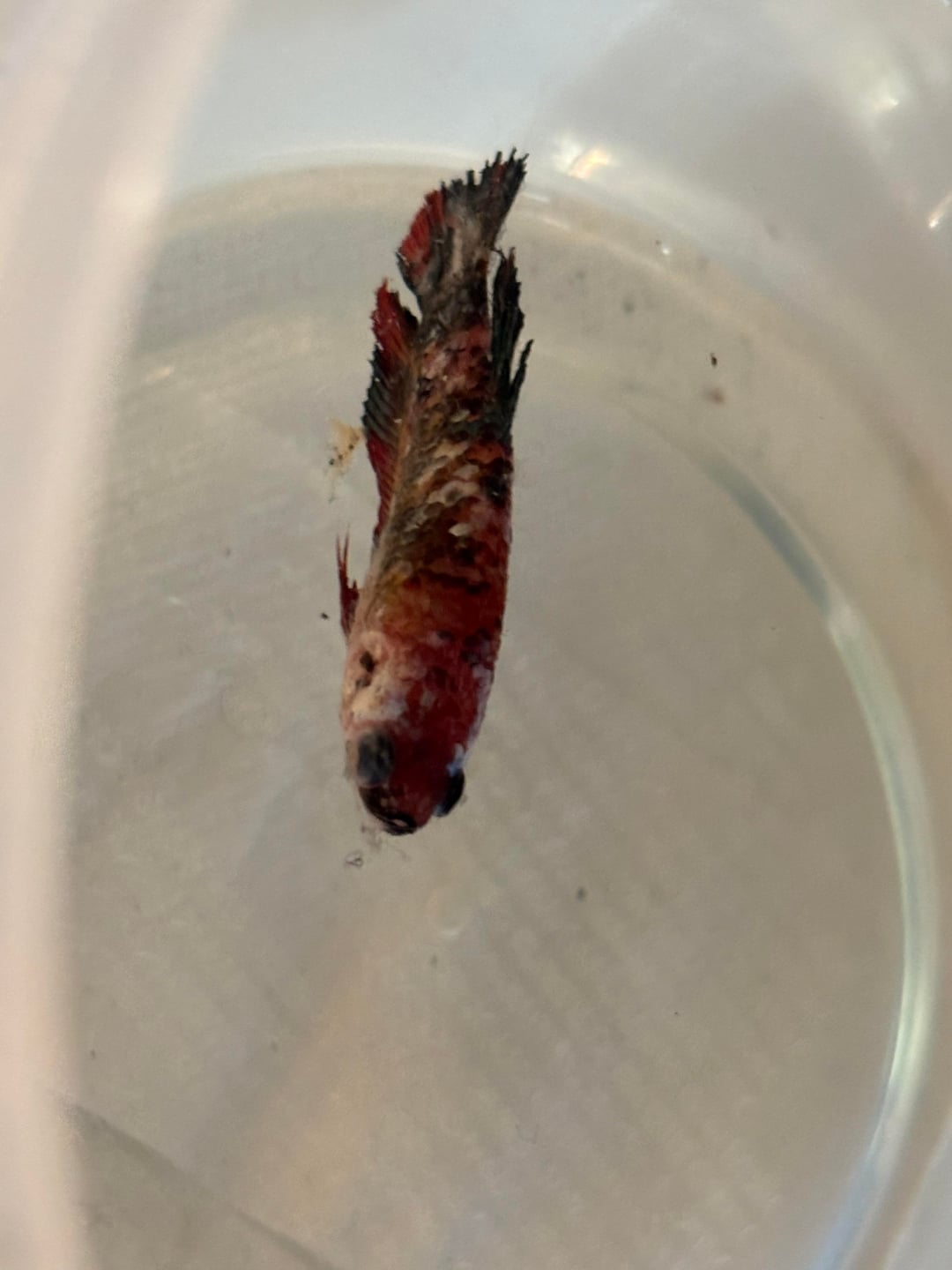
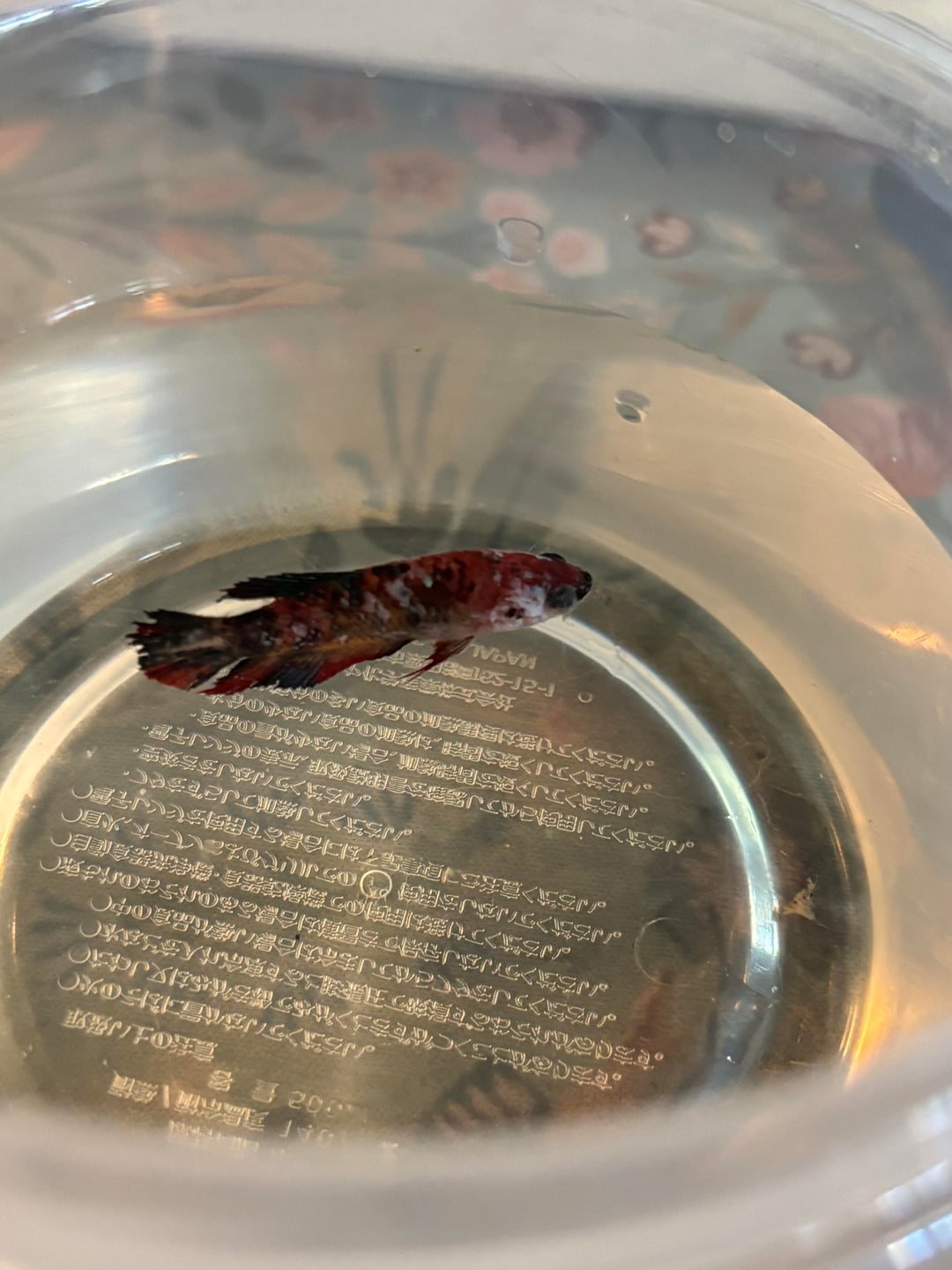
I come home to find my betta fish, Narvi, practically mangled outside of her tank. While I assumed she was dead at first, she just jolted and I immediately put her in a lid I had nearby me with some water. Many of her scales scattered throughout the bottom and I genuinely do not know how she's still barely alive but she is. After a few minutes she began to move around ever so slightly so I transferred her to a container, put a stress coat solution since it's the only thing I have on hand rn, and covered the container to keep it dark. I'm almost certain this was my cat, she's always trying to drink out of the tank but out of the many bettas I've had throughout my life not once have I seen her attack one or try to reach in the tank. Not that that I'm trying to down play the situation here by saying my cat would never do this but I'm trying to emphasize that I have never dealt with something like this before and I'm just in utter shock.
I know she's in terrible condition but I'm not sure if there's something I could do to just make things easier for her or if she even has a chance at surviving. I'm just not sure what to further do or what medications I could buy to help her recover if she even can.
https://www.reddit.com/gallery/1rk6fa1
Posted by giscowww
10 Comments
To add, she is trying to swim around now but her condition is still so very poor ofc. I don’t know if that’s really an indication that there’s a chance she may survive
she needs to go back in her tank, do 25% water changes every week and keep light off for around a week, if you notice any fungal growth or fluffy white/extreme red irritation you need to treat asap. is she eating?
i’m so so sorry. while i’m not well versed in injury treatment for bettas and so i’ll let others speak on that, please at least get a hospital tank for the fish. she has just been injured and needs time and careful observation to recover.
also, and this is not to be rude, but now you have seen why people often warn on letting cats have unsupervised access to much smaller prey animals like fish (as well as rodents, lagomorphs, birds, and others). your cat, regardless of how well you know them, is capable of hurting your fish. please invest in lids for any other tanks you may have, including your betta’s original tank as well as the hospital tank.
I’m so sorry for you and your fish. The stress coat is a great start. Additional things you can add are an antibiotic like kanaplex and tannins. Scales can heal/regrow over time, but is there any other injuries? It’s hard to tell but that looks like a puncture wound which would make her chances of survival a little more bleak.
She’ll be better off in a tank that has a heater and has familiar water parameters. Making sure the water has good oxygen will help too.
Is she having trouble staying upright?
Other people have given good advice on medications and such so I just wanted to say based on the pics and the behavior you’re describing from her it seems like she has a chance. I’m sending you both good vibes & wishing her the best at recovery ❤️🩹
I vote for some sort of antibiotic for two reasons: cat wounds are germy, though I don’t know if any of their pathogens can pass to fish, and secondly, her immune system is weakened by the injuries and she may be more susceptible to a secondary infection.
I also second hospital tank, which can just be a bucket (probably should be covered to keep the cat out) with a heater and filter.
Sending vibes for Narvi 🥺🥺🥺🥺
Absolutely an antibiotic as others said. Cat bites deliver an incredible amount of dangerous bacteria. Animals can die from minimal trauma with cat bites due to this alone.
Set up a hospital tank with some artificial hides and silk plants, a heater, thermometer, filter, AND A LID. Ideally setup a 5 gallon as that will jot only giver her swimming space but will also make dosing medications easier. I would personally do a combination of aquarium salt, tannic acid (put things like catappa leaves in), seachem stress guard (alternative API stress coat) and a broad-spectrum antibiotic and anti fungal like kanaplex (kanamycin sulfate). Ideally the kanaplex would be dosed in the food and the medication can be more effective that way. Metroplex (mentronidazole) can also be used safely with kanaplex for additional coverage of opportunistic protozoans. The aquarium salt can help with swelling and disinfecting external wounds, and the tannic acid has some anti-microbial effects that can make the environment less hospitable to certain microbes.
I personally like preparing medicated food with a mixture of frozen foods. For a betta fish I would do something that combines frozen bloodworms, brine shrimp, mysis shrimp, and daphnia. Hikari actually sells a freshwater multipack which contains those things plus other things which are good or ok for your betta to eat. Defrost 7 cubes and add 1 scoop of kanaplex (1 scoop of focus recommended for better binding to the food but not necessarily. 1 scoop metroplex if using it with kanaplex, but know it can make the food taste more bitter so fish may not eat it). Throughly mix the medication in with the defrosted food until fully dissolved, then carefully pour the mixture into a clean tray or back into the tray they came from (don’t let it come into contact with non-medicated food though), and allow for it to freeze completely. Feed your betta this for at least one week and then consider whether further treatment may be needed afterwards.
If your betta stops eating midway through try seeing if they will eat their regular food as it may be that they simply don’t want the medicated food. If they also won’t eat their regular food then things may be getting worse. If you need to start dosing medication in the water then start it the day after the last time they ate the medicated food. Water based administration of medication is not always as effective as food based administration so if you can go the food route I would recommend it. The water route can work as well if the food route isn’t able to be done. Cats carry a ton of bacteria in their mouth that can easily and quickly infect smaller animals so treatment needs to be started ASAP. Stress can also have a severely negative impact on betta fish health so try to minimize sources of stress as much as possible. Best of luck to you and your fish OP.
Oh my gosh! That poor baby!
I don’t know if your fish will survive this, but your best bet is to dose her water with SeaChem Stress Guard daily until she heals.
Cat mouths and claws are absolutely TEEMING with bacteria and if you don’t treat her wounds they will get infected and she will die.
I know this isn’t the same thing but I had a coworker who was assured by some pet store employees that she could put a betta in with some red fin sharks and they would be fine. Within 12 hours that betta’s fins were torn to shreds. She gave him to me and I put him in a hospital tank at home with some live plants and places to hide and dosed him daily with stress guard until his fins started to grow back. He never flared at me the whole time he was in my hospital tank so I took a chance and put him in my 20 gallon long with my peaceful nano species and he did really well in there. He didn’t seem to have any PTSD from his attack and he never chased or nipped the other fishes in my community tank.
I said the above to try to give you hope that she might be able to come back from this.