
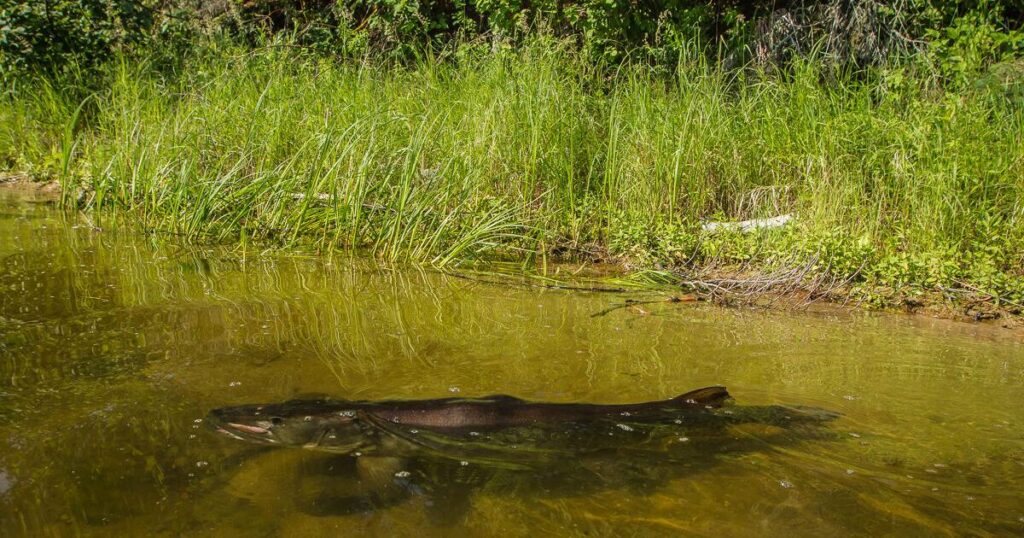


Photo by Jillian A Brown Photography
A kayak trip near Coney Island turned into the wildlife encounter of a lifetime — albeit a bittersweet one — for photographer Jillian A. Brown when she came across a large muskie swimming along the surface of Lake of the Woods.
Brown, who spends her summers at her family’s cottage on the island, was heading toward a nearby marsh to photograph wildlife when she noticed something moving through the water.
“I couldn’t recognize what it was,” she told the Miner and News. “So I kayaked over to it and realized it was a massive fish.”
Brown estimates the muskie was between 45 and 50 inches long — or precisely 48 inches if she had to guess.
She had seen muskies around the island before, but usually only briefly before they disappeared into the darker water. This one was different. It remained at the surface, continuing to swim alongside her kayak.
As she got closer, Brown noticed lumps on its back, leading her to think something might be wrong.
“It was just slowly making its way along the surface,” she said. “I just kayaked with it for a little while, swimming along, and it stayed right beside my kayak with me.”
Brown followed the fish along the shoreline and into a small, sheltered bay, where she noticed it trying to push itself toward the beach.
Having seen salmon behave in a similar way during spawning season in British Columbia, she initially wondered whether the muskie might be doing the same thing. But as she looked more closely, she began to question whether that was the case.
“I could see more and more of these weird lumps and sores on it,” she said. “That’s when I started to wonder if it might be sick.”
Pulling her kayak onto shore, Brown walked through the shallow water beside the fish. Using her waterproof phone camera, she captured video both above and below the surface.
“I use my phone to document a lot of the turtles and snapping turtles around the cottage here,” she said. “It was just amazing to be able to put my phone underwater and capture the fish in such beautiful light, showing off its colours and everything.”
Brown eventually left the bay and continued into the marsh to take photographs. About an hour later, she returned to check on the muskie and found it dead, floating in the water.
“That kind of gave me my answer,” she said. “I don’t think it was spawning.”
Brown waded into the water and pulled the fish closer to shore, giving her the rare opportunity to see its size, scales, gills and colours up close.
“You don’t get that often when a fish passes away, especially one as beautiful as that,” she said. “The birds and the other things usually get it, or it sinks. So it was really incredible to see such an old and beautiful creature right up close like that.”
Brown said she could not see a hook or any other obvious indication the muskie had recently been caught or mishandled.
After doing some research and hearing from people who saw her video, Brown wondered whether the muskie may have had lymphosarcoma. She believes it could explain the lumps and sores she saw on the fish, although the cause of its condition and death has not been confirmed.
“I think it probably lived a pretty long and full life,” she said. “It looked like it was a disease and that it hopefully died of a natural cause.”
Brown first shared a short video of the muskie swimming beside her kayak in a Coney Island Facebook group. As others began sharing the video, she decided to put together a longer version showing more of the encounter.
It didn’t take long for the video to spread well beyond the local group.
Brown has kayaked throughout North America, completed expeditions and had numerous wildlife encounters, but said she has never had anything receive the same response online.
“I’ve never had anything go so viral as a video of a muskie swimming beside my kayak,” she said. “Nothing’s come close.”
The attention also brought speculation about what had happened to the fish, including comments suggesting its condition could have been related to fishing or improper handling. In response, Brown shared additional footage showing the sores on the fish after it died.
Because the muskie had died near a private dock, Brown spoke with the property owner before moving it to a nearby marshy area, where it could become food for other wildlife.
“It’s a bittersweet thing because I would love for that fish to still exist and be in the waters,” she said. “To get to have a moment like that and to respect it too … I got to take it away and lay it to rest in a marshy area where I know other animals and scavengers will have the opportunity to feed on it, which is nice to know that it’s not going to go just to waste.”
For Brown, the encounter happened in a place that has been part of her life since childhood.
She has spent summers and weekends on Coney Island since she was born. Her family’s connection to the property now spans five generations, and part of it was passed down to Brown and her brother this year.
“I could basically probably swim before I could walk,” she said.
Swimming lessons at Coney Beach eventually grew into a life spent sailing, swimming, kayaking and canoeing.
Brown now lives near Squamish, B.C., but for the past five years she and her husband have returned to the family cottage for about four months each summer.
“It’s just part of our soul, our family’s soul, this area,” she said. “It feels like home, even if home base is somewhere else. This is always where our hearts are, I think.”
This summer, being back on that familiar stretch of water put Brown in the right place at the right time for an unexpected encounter.
“The timing of being there was just perfect,” Brown said. “I’m very grateful to have got to witness all of that and experience it.”