
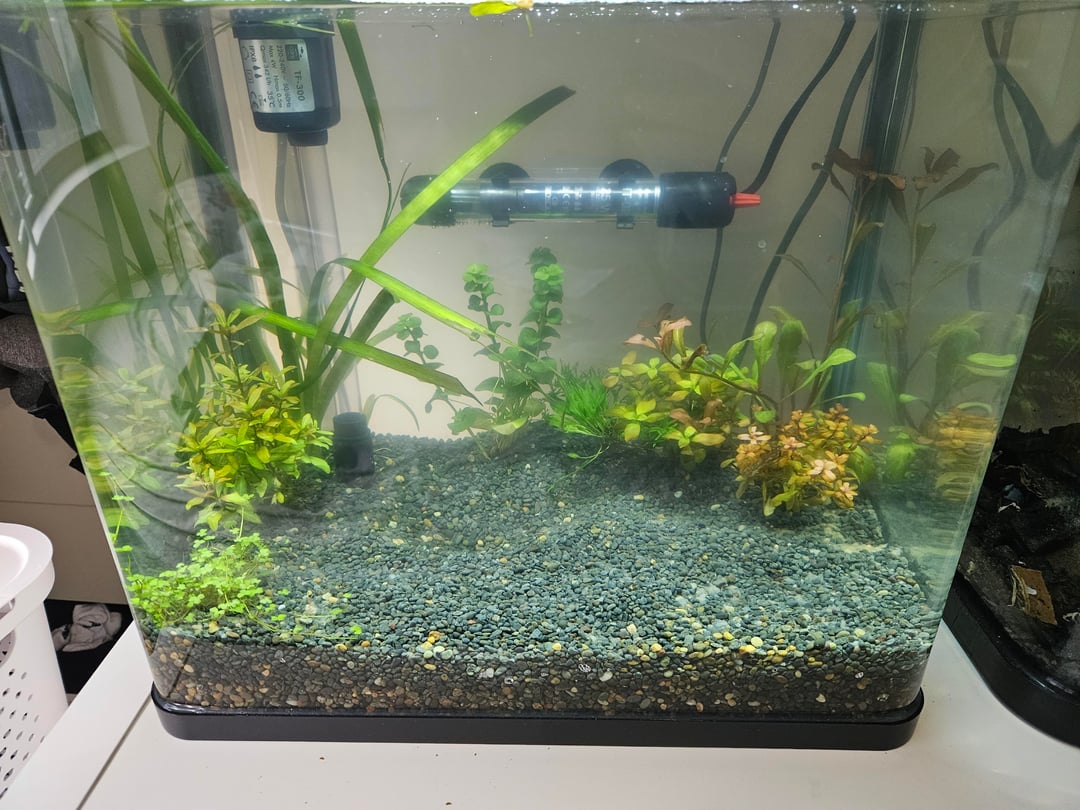
Hi all, I just built a new planted tank for a betta fish. I'm currently beginning the tank cycle using fish food for ammonia.
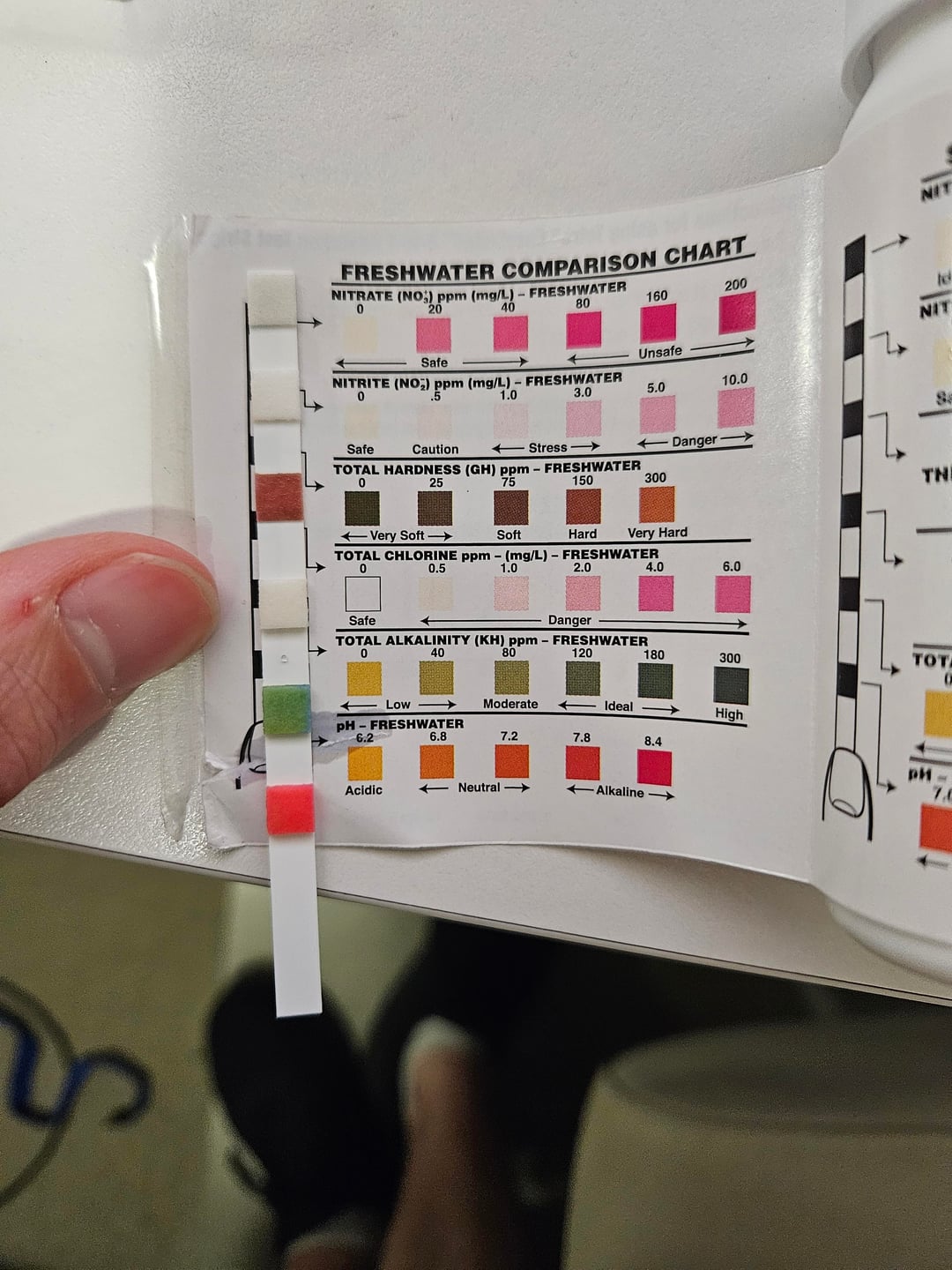
My ammonia levels are going up at 0.5-1.0 ppm (different teat no pic) but I've noticed some of the plants aren't looking healthy with leaves fading so I got a 6 in 1 test kit and found that the water is high pH (alkiline) and hard (150 GH). Everything else seems okay.
Do I need to address the pH or hardness at the moment? Would those parameters negatively affect the plants?
Any advice is greatly appreciated!
Posted by NaraboongaMenace
3 Comments
A lot of plants will have an initial melting phase because they were either grown out of water or in completely different conditions like with co2) than your tank, so this isn’t unusual for a brand new set up.
Did you use any root tabs under the gravel? Might be good to look into that if you’re planting into an inert substrate 🙂
Some plants will definitely do better in hard water than others, so your tougher plants like crypts and Anubias and Amazon swords, but I’ll wait for someone else to chime in on that cause I only have experience with very soft water.
Everyone is going to say this but I would highly highly recommend you ditch the test strips when you can and get a liquid test kit like the API master test kit, it’s gonna be way more accurate than strips. More accurate tests = more accurate tracking of where you’re at in your cycle and can save you a lot of heartbreak and confusion in the future!
The only other thing I will mention is it looks like you’ve got a java fern in the back, that one definitely cannot be planted in the substrate. I’d recommend using some aquarium safe glue and sticking the rhizomes (hard green bit that the leaves and roots grow out of) to some driftwood or some smooth rock, or using some cotton to tie it to one of those. If the rhizome is buried the whole thing will rot!
🙂
Do you know your tap waters pH?
Hi there, yes I would say the pH and hardness is impacting your plants, it will also impact the future betta fish. Both look maxed out on the test strip which means they could be higher. Kudos for picking up on this.
The plants will need an adjustment period being new in the tank, but long term the pH and hardness need addressing anyway as they plus the betta will struggle in this. I would recommend more accurate testing with a liquid test kit for pH, KH and GH to get the actual figures more accurately.
I would recommend testing your tap water (or water source) for comparison to see if it’s something in the tank or the water source that’s driving it up. If the water source, the time is now to start working out how to address this.
It looks like the mineralisation is driving it up based on the strip (hardness = general hardness (GH) which is a measure of the calcium, which makes it a little more complicated. You may need to begin researching using purified water and remineralising for the aquarium – for this you will definitely need the liquid test kits for pH, KH and GH. The benefit is there are no fish yet so this is the time to sort the water chemistry.
Purified water such as deionised (DI), reverse osmosis (RO) and distilled have had the minerals stripped and sit at neutral pH. It is vital to remineralise before use as pure water isn’t good for fish, plants or the good bacteria of the nitrogen cycle. The whole process sounds a lot more complicated than it is, this link gives a general overview and info:
https://24purewater.co.uk/distilled-water-for-aquarium/
The relationship of pH, KH and GH is described in this, though test strips are offered for guidance:
https://www.aquariumcoop.com/blogs/aquarium/ph-gh-kh
Betta have a comfortable pH range of pH 6.5 – pH 7.5, with a little wiggle room either side. As a soft water fish when they are out into hard alkaline water it causes serious health issues over time. Alkalosis (alkaline poisoning) comes on with time causing fin degradation, brittle scales, lethargy, impacted metabolic function and serious organ damage as the body struggles to cope with processing the excess minerals. This shortens lifespans and can make the fish very sick.
For information pH is logarithmic so a small difference in numbers is actually larger. pH 8.4 is 10 x more alkaline than pH 7.4 and 100 x more alkaline than pH 6.4. Saltwater setups sit around pH 8.2, very few freshwater fish cope long term in high hardness and alkanity.
Hope this helps.